Home Blog Page 99

Prez Siriena’s recent actions are shocking says students of South Asian University, New Delhi

“The mandate of the 2015 election in which Your Excellency was elected as President pledged to abolish the executive presidency and mitigate the balance of power between the Parliament and the Executive. However, it was shocking to see Your Excellency’s recent act as the Head of State, which has gone against this mandate and the promise given to the electorate to usher in a period of good governance.” says students of South Asian University, New Delhi in a letter addressed to president Sirisena.

Letter fellows:

His Excellency Maithripala Sirisena, 

The President of the Democratic Socialist Republic of Sri Lanka

The President’s Office

Colombo 1

Sri Lanka

29 October 2018

Through the Deputy High Commissioner

Sri Lanka High Commission

27, Kautilya Marg

New Delhi

Your Excellency,

Removal of Prime Minster Mr Ranil Wickramasinghe and the Appointment of Mr Mahinda Rajapaksa as Prime Minister

We, students of South Asian University, New Delhi are concerned about the developing uncertainty in the political scenario of Sri Lanka consequent to the removal of the Prime Minster Mr Ranil Wickramasinghe, and the appointment of Mr Mahinda Rajapaksa as the new Prime Minister. This act, which has been carried out amidst much secrecy and without a floor vote in Parliament has already cost people’s lives and considerable disruption of public life. At the moment, we are not debating the legality of this action in terms of the constitution. We are concerned of the ethics of the action and the political uncertainty it may push the country into. We are well aware of the uncertainties which governed Sri Lankan politics and day to life in the recent past, and it would be singularly unfortunate if this action would push the country in this direction again.

The mandate of the 2015 election in which Your Excellency was elected as President pledged to abolish the executive presidency and mitigate the balance of power between the Parliament and the Executive. However, it was shocking to see Your Excellency’s recent act as the Head of State, which has gone against this mandate and the promise given to the electorate to usher in a period of good governance. This action is both politically counter-productive as it is also a direct threat to the survival of democratic traditions in the country. Compared to much of South Asia, Sri Lanka was taking reasonable strides towards accountable democracy over the last two years. Your recent action has hampered this progress, and as young people of South Asia we are very concerned of the impact this act will have not only in Sri Lanka, but by extension, on South Asia more generally.

In this context, we urge you to lift the postponement of Parliament and reconvene Parliament without further delay and ensure that a floor vote takes place on an urgent basis to ascertain which leader currently commands a majority in Parliament.

Such action will ensure that stability will return to Sri Lanka along with the confidence of the international community, which is at the moment clearly lost .

Yours sincerely,

Singed by 250 students of the  of South Asian University, New Delhi

Unconstitutional removal of PM Ranil Wickremasinghe – Dr. Jayampathy Wickramaratne

(Summary of statements made by (Dr) Jayampathy Wickramaratne, President’s Counsel and Member of Parliament at media briefings on the crisis triggered off by the purported unconstitutional removal of the Prime Minister)

A constitutional crisis has been precipitated with President Sirisena purporting to remove Prime Minister Ranil Wickremasinghe and purporting to appoint Mahinda Rajapakse MP as Prime Minister on 26 October 2018.

Before the Nineteenth Amendment to the Constitution (which came into force on 15 May 2015) Article 43 of the Constitution provided as follows:

“The President shall appoint as Prime Minister the Member of Parliament who in his opinions is most likely to command the confidence of Parliament.”

The President also had the power to dismiss the Prime Minister. Article 47 stated:

“The Prime Minister, a Minister of the Cabinet of Ministers, any other Minister or Deputy Minister shall con­tinue to hold office throughout the period during which the Cabinet of Ministers continues to function under the provisions of the Constitution unless he –

(a) is removed by a writing under the hand of the President ;

(b) resigns his office by a writing under his hand addressed to the President ; or

(c) ceases to be a Member of Parliament.”

Changes brought about by the Nineteenth Amendment

By the Nineteenth Amendment, Parliament was strengthened. The President’s power to dissolve Parliament at any time was severely restricted. Under Article 70 as amended, the “President shall not dissolve Parliament until the expiration of a period of not less than four years and six months from the date appointed for its first meeting, unless Parliament requests the President to do so by a resolution passed by not less than two-thirds of the whole number of Members (including those not present), voting in its favour.”

The appointment of the Prime Minister is now governed by Article 42 (4) which states: “The President shall appoint as Prime Minister the Member of Parliament, who, in the President’s opinion, is most likely to command the confidence of Parliament.” Ministers, non-Cabinet Ministers and Deputy Ministers are appointed by the President only on the advice of the Prime Minister, vide Articles 44, 45.

The power of the President to remove the Prime Minister, a Minister or a Deputy Minister was taken away. A provision similar to former Article 47 (a) does not now appear in the Constitution. A Minister or a Deputy Minister can now be removed only on the advice of the Prime Minister, vide, Article 46 (3) (a). In such a situation, it is absurd to argue that the Prime Minister can be removed by the President at will, especially as former Article 47 was expressly repealed.

The holding of office by the Prime Minister is now governed by Article 46 (2) which states as follows:

“The Prime Minister shall continue to hold office throughout the period during which the Cabinet of Ministers continues to function under the provisions of the Constitution unless he –

resigns his office by a writing under his hand addressed to the President;

or

(b) ceases to be a Member of Parliament.”

The three circumstances under which the Cabinet of Ministers stands dissolved are clearly set out in Article 48 (2):

“If Parliament rejects the Statement of Government Policy or the Appropriation Bill or passes a vote of no-confidence in the Government, the Cabinet of Ministers shall stand dissolved, and the President shall, unless he has in the exercise of his powers under Article 70, dissolved Parliament, appoint a Prime Minister, Ministers of the Cabinet of Ministers, Ministers who are not members of the Cabinet of Ministers and Deputy Ministers in terms of Articles 42, 43, 44 and 45.”

None of the above three situations have occurred. In fact, a motion of no-confidence brought against the Prime Minister was defeated by a comfortable majority of 46 votes on 04 April 2018. Nothing has changed thereafter. Even on the 25th and 26th of October 2018 several Bills, Orders and Resolutions presented by the Government were passed and these included the Finance Bill, a Money Bill.

It has been pointed out that the Sinhala version of Article 48 (1) the Constitution refers to the dissolution of the Cabinet of Ministers upon the “removal of the Prime Minister”. The English version, on the other hand, does not contain those words:

“On the Prime Minister ceasing to hold office by death, resignation or otherwise, except during the period intervening between the dissolution of Parliament and the conclusion of the General Election, the Cabinet of Ministers shall, unless the President has in the exercise of his powers under Article 70, dissolved Parliament, stand dissolved and the President shall appoint a Prime Minister, Ministers of the Cabinet of Ministers, Ministers who are not members of the Cabinet of Ministers and Deputy Ministers in terms of Articles 42, 43, 44 and 45.”

However, there is no specific provision in the Constitution, in either the Sinhala or English versions, that empowers the President to remove the Prime Minister. In the absence of such a specific provision in the Constitution and the repeal, by the Nineteenth Amendment, of the specific provision that was in the original Constitution, it cannot be said that the President can remove the President at will. As such, the words “removal of the Prime Minister” in the Sinhala version of Article 48 (2) can only be interpreted to mean the removal of the Prime Minister upon Parliament rejecting the Statement of Government Policy or the Appropriation Bill or passing a vote of no-confidence in the Government. Any other interpretation would be against the wishes of the People expressed at the Presidential Election held on 08 January 2015 and the intention of Parliament in adopting the Nineteenth Amendment.

Applicability of the Interpretation Ordinance

It has been argued that although there is specific constitutional provision that the President could remove the Prime Minister, section 14 (f) of the Interpretation Ordinance empowers the President to do so, being the person who appoints the Prime Minister. Section 14 (f) states: “for the purpose of conferring power to dismiss, suspend or re-instate any officer, it shall be deemed to have been and to be sufficient to confer the power to appoint him.”

Sri Lankan courts have consistently held that the Interpretation Ordinance has no application to the interpretation of the Constitution. The latest case is the Opinion expressed by the Supreme Court in SC Reference 01/2014 on 10 November 2014 when President Rajapakse requested an opinion on whether he could run for a third term under the Eighteenth Amendment. A Full Bench of the Supreme Court unanimously held that the argument that the Interpretation Ordinance applies to constitutional interpretation was erroneous.

The Supreme Court stated that the dicta of Sri Lankan courts shuts out the applicability of the Interpretation Ordinance and referred to the decision of the Supreme Court in SC Reference 03/08 where S.N. Silva CJ, Amaratunga J and Ratnayake J held that the constitutional provisions stand at the zenith of the normative triangle. The Court also referred to the case of Peter Attapattu v. People’s Bank, reported in 1997 Sri Lanka Law Reports volume 1 at page 208, where the Supreme Court stated that where a contrary position is found in the Constitution vis-à-vis the provisions of the Interpretation Ordinance, the constitutional provisions prevail. The Court also referred to several judgments of foreign courts and a statement by Retired Chief Justice Sharvananda in his book ‘Fundamental Rights in Sri Lanka’ at page 43.

National Government

Article 46 (1) of the Constitution as amended by the Nineteenth Amendment fixes the maximum number of Minister of the Cabinet Ministers at 30 and the total number of non-Cabinet Ministers and Deputy Ministers at 40. However, Article 46(4) provides that where the recognized political party or the independent group which obtains highest number of seats in Parliament forms a National Government, the number of Ministers in the Cabinet of Ministers, the number of Ministers who are not Cabinet of Ministers and the number of Deputy Ministers shall be determined by Parliament.

It has been argued that as a National Government had been formed after the General Elections of August 2015 and now that the United People’s Freedom Front led by President Sirisena has withdrawn from the same, the Cabinet of Ministers stands dissolved.

However, Mr. Ranil Wickremesinghe was appointed Prime Minister after his United National Party won the highest number of seats at the General Elections held on 17 August 2015. President Sirisena appointed him as Prime Minister on 21 August 2015 as the Member of Parliament who in his opinion is most likely to command the confidence of Parliament. Soon thereafter, three Ministers were appointed on the advice of Prime Minister Wickremesinghe: Messrs. Mangala Samaraweera, Tilak Marapona and Wijedasa Rajapakse. When the new Parliament convened on 01 September 2015, Mr. Wickremesinghe was already Prime Minister.

On 03 September 2015, a resolution was introduced in Parliament by Prime Minister Wickremesinghe under Article 46 (4) to increase the number of Ministers as the United National Party had formed a National Government. The resolution read as follows: “Whereas the United National Party which obtained the highest number of seats in Parliament has formed a National Government, Parliament determines in terms of Article 46(4) of the Constitution of the Democratic Socialist Republic of Sri Lanka that the number of Ministers in the Cabinet of Ministers shall not exceed 48 and the number of Ministers who are not Cabinet Ministers and the number of Deputy Ministers shall not exceed 45.” The resolution was passed.

The resolution that was passed did not mention the United People’s Freedom Alliance. In fact, not only the United People’s Freedom Alliance but the lone Member of Parliament who was elected from the Batticaloa District on the Sri Lanka Muslim Congress ticket also joined the National Government. Other members of the Sri Lanka Muslim Congress were elected on the United National Party ticket.

Thus, Mr. Wickremesinghe was not appointed to the office of Prime Minister upon him becoming the Member of Parliament who in the President’s opinion is most likely to command the confidence of Parliament after the United People’s Freedom Alliance joined the Government. He was appointed on the strength of his own party’s strength in Parliament.

Thus, the withdrawal of the United People’s Freedom Alliance has no effect on the appointment of Mr. Wickremesinghe as Prime Minister on 21 August 2015.

Further, the formation of a National Government is exclusively a matter for Parliament. The only consequence of a National Government ceasing to exist is that the number of Ministers goes down to 30 and total number of non-Cabinet Ministers and Deputy Ministers goes down to 40. In any case, the National Government continues as the Sri Lanka Muslim Congress continues to be in it.

Conclusion

From the above, it is clear that the purported removal of Mr. Ranil Wickremesinghe from the office of Prime Minister and the purported appointment of Mr. Mahinda Rajapakse as Prime Minister are unconstitutional and all subsequent steps taken are void ab initio.
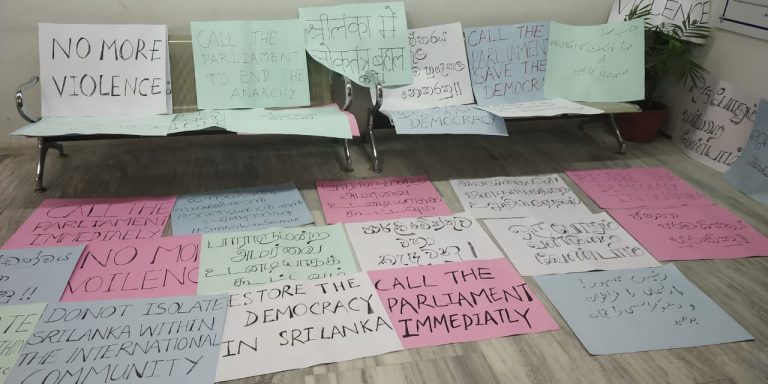
 

European Union requests Sirisena to reconvene the Parliament immediately.

Statement by the Spokesperson on the situation in Sri Lanka.

Bruxelles, 29/10/2018 .


The sudden deterioration of the situation in Sri Lanka over the weekend puts the country at risk of instability and unrest.

Along with other key international partners of Sri Lanka, the Ambassador of the European Union met today with the President of Sri Lanka, Maithripala Sirisena, to express our expectation that a solution respectful of the country’s constitution would be found quickly. To this end, it is important that the President allows the immediate reconvening of the Parliament so that the elected representatives of the Sri Lankan people can fulfil their duties.

In the current context of tensions and uncertainties, it is of utmost importance that violence and provocation are avoided and that law enforcement agencies act with restraint.

The EU expects Sri Lanka to pursue its positive path towards reconciliation and democracy for the full benefit of the Sri Lankan people.

Maja KOCIJANCIC

Spokesperson for Foreign Affairs and Security Policy/European Neighbourhood Policy and Enlargement Negotiations.

EU

The Centre for Policy Alternatives (CPA) condemns Sirisena’s action in the strongest possible terms

CPA Statement on the Current Constitutional Crisis.

October 29th 2018, Colombo, Sri Lanka: The Centre for Policy Alternatives (CPA) condemns in the strongest possible terms the attempt by President Maithripala Sirisena to purportedly remove Prime Minister Ranil Wickremesinghe from office and appoint Mr Mahinda Rajapaksa as the Prime Minister instead. We firmly believe that these acts are unconstitutional and illegal, and wholly lacking in democratic legitimacy.

The Nineteenth Amendment to the Constitution (2015) took away the power previously held by the President to dismiss the Prime Minister. This is the effect of Articles 42(4), 46(2), and 48 of the Constitution. While the President retains the ceremonial task of appointing the Prime Minister in terms of Article 42(4), this is not a subjective decision or power of the President, and he only act under this provision subject to the confidence of Parliament in the Prime Minister. The circumstances in which the Prime Minister ceases to hold office, on the other hand, are now specifically and formally set out in the Constitution. Unless the Prime Minister ceases to function in office by death, resignation, or by ceasing to a Member of Parliament, the only other way in which the Prime Minister can be removed is if the Prime Minister loses the confidence of Parliament, expressed through a defeat on the Statement of Government Policy, the Appropriations Bill, or through a motion of no-confidence as per Article 48(2). The House has not expressed its loss of confidence in Prime Minister Wickremesinghe, the necessary conditional precedent, prior to his purported removal by the President on 26thOctober 2018.

We firmly reject the argument that the effect of the withdrawal from the National Government, as defined in Article 46(5), of the Constitution by the United People’s Freedom Alliance (UPFA) means that the Cabinet of Ministers is dissolved and the serving Prime Minister ceases to hold office. The underlying rationale of Article 48(1), on which this argument is based, is to dissolve the Cabinet when the Prime Minister ceases to hold office, and not the reverse. If the purported removal of the Prime Minister is unlawful, then there can also be no dissolution of the Cabinet.

The lack of legality and legitimacy in the presidential actions of Friday evening, which seem to have been planned secretively and executed with a suddenness that took the entire country by surprise and disbelief, is exacerbated by the President’s prorogation of Parliament. Only Parliament has the constitutional authority to determine the continuation in office of the Prime Minister, or a change of Prime Ministers. By its prorogation, the country cannot resolve the unprecedented constitutional crisis into which it has been plunged, and it fundamentally calls into question the democratic legitimacy of the President’s purported appointment of a new Prime Minister.

The current constitutional crisis is unprecedented in that Sri Lanka has never had the legality and legitimacy of its government called into question in this way. We regret and deplore the course of action that has resulted in this unnecessary crisis and democratic backsliding. It is astonishing and disappointing that a President elected with a mandate to strengthen constitutional democracy, the Rule of Law, and good governance has chosen this course.

CPA therefore reiterates its unequivocal condemnation of the unconstitutional attempt at a transfer of power, and urges the reconvening of Parliament immediately in order that it may decide the matter conclusively.

Finally, we are also gravely concerned with the ensuing violence that resulted in the first casualty this weekend. With the crisis continuing into its third day, genuine fears point to an escalation of violence if the crisis is not swiftly addressed. It is paramount the present crisis is resolved immediately in order to prevent political violence and protect the lives of all citizens.

President Sirisena’s actions have put Sri Lankan democracy in peril – The Hindu

Avoidable crisis: on Sri Lanka’s political crisis, Editorial, The Hindu.
OCTOBER 29, 2018.

President Sirisena’s actions have put Sri Lankan democracy in peril.

Sri Lankan President Maithripala Sirisena’s decision to withdraw his faction from the ruling coalition and replace Prime Minister Ranil Wickremesinghe with former President Mahinda Rajapaksa has plunged the country into a political crisis. This was further complicated, a day later, by the President’s move to suspend Parliament till November 16. Mr. Sirisena’s fast-deteriorating relationship with Mr. Wickremesinghe was an open secret, and there were indications that he could be negotiating a possible partnership with Mr. Rajapaksa. But his sudden and secret manoeuvre caught everyone, including senior politicians, completely unawares. And before the details and implications of the political drama that was unfolding could sink in, Mr. Rajapaksa had been sworn in Prime Minister, beaming as he greeted the President, his chief rival until days ago. Mr. Wickremesinghe has termed his replacement “unconstitutional” and maintains that he remains Prime Minister. Confident of a majority, he has challenged the Rajapaksa-Sirisena combine to take a floor test in the 225-member House.

By suspending Parliament, Mr. Sirisena is seen to have exposed his own insecurity about garnering the required strength. The next two weeks will be crucial, with attempts at horse-trading and assertions of political loyalty amid uncertainty. None of these is uncommon in Sri Lankan politics, but the circumstances, which are entirely of Mr. Sirisena’s making, have led to a political upheaval that was avoidable. All this has come at a time of economic fragility, with a plummeting rupee, soaring unemployment and rising living costs.

Mr. Sirisena’s appointment of Mr. Rajapaksa even before voting out Mr. Wickremesinghe on the floor of Parliament is nothing but blatant abuse of his executive powers. Guided by narrow political interests, the President’s actions betray an utter disregard for the parliamentary process. In resorting to these emergency measures, he has not only put democracy in serious peril but also let down Sri Lankans, including a sizeable section of the Tamil and Muslim minorities that backed him in the critical 2015 election.

The best forum to test political clout in a democracy is the legislature. An extra-parliamentary power struggle, that too using illegal means, heightens the risk of political thuggery and unrest. Still recovering from the violence and bloodbath during its nearly three-decade-long civil war, and grappling with the economic and social challenges in its aftermath, Sri Lanka cannot afford to recede from the democratic space that opened up in 2015.

Mr. Sirisena and Mr. Wickremesinghe had come together in an exceptional political alliance that promised to put the country back on the path of democracy, after a decade of Mr. Rajapaksa’s authoritarian rule. Leaving aside the irony of Mr. Sirisena joining hands with Mr. Rajapaksa, who he had left and subsequently unseated from office, his desire to consolidate power by hook or by crook is extremely unfortunate. Though much damage has been done already, a fair vote must be ensured when Parliament reconvenes, if possible before November 16.

Presidential coup that will send the Sri Lanka into darkness

By an activist of the 2015 social media group.

‘So Sri Lanka,’ you are back to square one!

In most countries when politicians fail, we see military coups; however in Sri Lanka, for the very first time, we are witnessing a presidential coup against the Legislature from a man who said to the people that he was not power hungry and was committed to reforms to build a more democratic nation.

Friday 26 October saw for the very first time the real dictatorial power of the executive president being executed, most probably masterminded by the two Rajapaksa brothers holding US citizenship.

The unlawful power grab from the Legislature saw all characteristic of a military coup, but this time led by the President of the country. The immediate action taken to use thugs of Podu Jana Peramuna to take over the national TV stations and Lake House speaks aloud as to who was behind them, as the President being the Minister in charge of the armed forces and national security allowed such actions within hours of giving oaths to a Prime Minister the country had not voted for.

Without batting an eye, the President led this coup, trying in his attempt to stay in power after 2019, using even the devil to do so. His story of the assassination plot indirectly linking India and Field Marshal Sarath Fonseka, together with Gotabaya Rajapaksa, shows the master plan behind this whole coup. This story was built to convince the people that he did the right thing to bring the Rajapaksas back to power.

Simply, if he was not satisfied with the actions taken by the Wickremesinghe-led Government on investigations, instead of bringing the very same man and his family whom he accused of being behind the plot to kill him in 2014, he should have taken Police powers and the Ministry under him and investigated the said plot and attempt on his life.

This whole drama looking at the actors is showing a clear plan of the Rajapaksas to get into power to avoid the exposure of themselves and the corruption as the country steps into next year with elections all year round.

The Budget was around the corner, and if Sirisena had any genuine intentions to topple the Government democratically and to stab the very same people who brought him into power, the ideal platform would have been to defeat the Budget, which is a democratic means to do so.

The funny but serious part of this whole episode is that Sirisena is now exposed not only to the country but to the whole world, that he was the force behind obstructing the justice being done against the corrupt Rajapaksa regime. If not, no one with any senses could imagine in anyway how he could bring the alleged murderers and rogues back into power to form a government with him. The arrogance and the illegality of Sirisena is more visible as he chose to engage in this coup on a Friday evening even without informing the coalition partner in Parliament but pulling the rug to give the surprise element.

If he was a decent man, who was never destined to be the President of this country, he should have had the courtesy to inform the UNF, which included many smaller minority parties, that the UPFA was withdrawing from Government. With the existing Prime Minister still not being aware and being out of Colombo, he installs another Prime Minister at 7 o’clock in the evening, and then informs the existing Prime Minister at 10 o’clock in the night that he is removed. The removal should have been the first step if he was genuine in his business.

As citizens we must understand that this is a politically-failed coup that will sustain short-term happiness for a few, but it will create havoc not just for days, but for years to come, as the very same man who came to power promising a new governance system has led the nation and its people into a new political culture. There is no doubt that it is thugs and murderers who have taken over and that the country will have a huge cost for this blunder and the coup executed by the President on its own people.

Sri Lankans will have to dearly pay for this once again. It is very clear by the statements made by the US, EU and UK that our relationship with the West will once again be at odds as human rights and constitutional behaviour had been highlighted in their media releases and obviously the Rajapaksas will not stand qualified to deliver them.

Last time we averted major economic sanctions due to a change of government. However, this miserably failed coup of the President which is exposed to any man with common sense will lead to further economic chaos.

No doubt young people and intellectuals will keep on leaving the country. Certainly, investments and tourism will be affected. Probably all macroeconomic and the critically-important reforms will come to a halt as patriotism and the war are bound to come upfront to win elections in the upcoming months. People like Wimal Weerawansa will be the stars to start the rhetoric against the West and India.

Certainly, Sri Lanka is back to square one. President Sirisena will be in history books as a traitor who betrayed his own words and the countrymen of Sri Lanka, and probably the first executive president to lead a coup, using J.R. Jayewardene’s still-alive executive powers. A word of caution to our sugar daddies in the West – since these countries never helped Sri Lanka to get out of its financial mess created by the Rajapaksas by 2015, they will now have to look at a strategic location of the Indian Ocean slowly but steadily being entangled in Chinese hands. God bless Mother Lanka!

If one recalls, we wrote an article with our opinion on 3 April with the caption ‘Sri Lanka is plunging into a pit of snakes and darkness’ (http://www.ft.lk/opinion/Sri-Lanka-is-plunging-into-a-pit-of-snakes-and-darkness/14-652570).

Fellow citizens, sadly we have now fallen into that pit and darkness; as an activist group for 2015 we hope Lasantha Wickrematunge, Thajudeen and Eknaligoda are allowed to rest in peace without digging up their bodies for political purposes alone by a President who betrayed 6.2 million voters.

FT

Global pressure rises on Sri Lanka president to defuse political crisis

Image: President Maithripala Sirisena sacked Ranil Wickremesinghe, and appointed ex-president Mahinda Rajapaksa as Sri Lanka’s new prime minister.(AFP)

  • China, long seen as a supporter of Rajapaksa, has already congratulated him on becoming prime minister
  • But India, the European Union and the United States have all urged the president to abide by the constitution
 COLOMBO: Sri Lanka President Maithripala Sirisena is under increasing pressure to uphold the island nation’s constitution and reconvene parliament after his decision to replace the prime minister triggered political turmoil.

Sri Lanka was plunged into the crisis on Friday when Sirisena sacked Prime Minister Ranil Wickremesinghe and swore in ex-president Mahinda Rajapaksa to replace him, breaking up a fragile coalition governing the island.

Wickremesinghe says his sacking was illegal and unconstitutional and maintains he is still prime minister, leading to a standoff between his party and labor unions loyal to Sirisena.

On Sunday, Arjuna Ranatunga, petroleum minister in the ousted cabinet, tried to re-enter his office, leading to clashes in which one person was killed and two were injured.

The crisis has important ramifications in a battle for influence in south Asia between Sri Lanka’s traditional ally India and China, a country that is playing an increasing role in the region.

China, long seen as a supporter of Rajapaksa, has already congratulated him on becoming prime minister.
But India, the European Union and the United States have all urged Sirisena to abide by the constitution.

“We call on the president, in consultation with the speaker, to immediately reconvene parliament and allow the democratically elected representatives of the Sri Lankan people to fulfil their responsibilities to affirm who will lead their government,” US State Department spokeswoman Heather Nauert said in a statement.

Sources in diplomatic missions said most foreign envoys had yet to send congratulatory messages to Rajapaksa as it could be interpreted as legitimising the new government while there were still complaints his appointment was unconstitutional.

Market fallout
The political turmoil comes at a critical time for a Sri Lankan economy struggling with slow growth and a weakening currency.

If tensions continue, Sri Lanka could struggle to refinance government debt that comes due in early 2019 at an affordable rate, credit rating agency Moody’s said.

The country’s bonds sold off on Monday, while the Sri Lankan rupee fell 0.58 percent to an all-time low.
“The president’s sudden appointment of Mr.Rajapaksa as prime minister significantly heightens policy uncertainty,” said Matthew Circosta, an analyst at Moody’s Sovereign Risk Group

“Additionally, the possible social tensions that may unfold in the next few weeks would have a negative impact on the economy, which is already growing slowly.”

India and western countries have previously expressed concern about Rajapaksa’s ties to China, after he ushered in billions of dollars of investment from Beijing to rebuild the country following the end of a 26-year war against ethnic Tamil separatists in 2009.

That investment has since put Sri Lanka deep in debt and forced it to hand over control of a strategic port to China.

UN Secretary General urges Sri Lanka to respect democracy, constitution

ECONOMYNEXT – The United Nations Secretary General António Guterres has expressed concern over Sri Lanka’s political crisis and has asked for democracy and constitution to be respected, his spokesman said.

“The Secretary-General is following the latest developments in Sri Lanka with great concern,”  Stéphane Dujarric, Spokesman for the Secretary-General said in a statement.

“He calls on the Government to respect democratic values and constitutional provisions and process, uphold the rule of law and ensure the safety and security of all Sri Lankans.

“The Secretary-General urges all parties to exercise restraint and address the unfolding situation in a peaceful manner.”

Sri Lanka was plunged into a political crisis Friday as President Maithripala Sirisena appointed Mahinda Rajapaksa as Prime Minister and suspended parliament until November 16 as incumbent Ranil Wickremesinghe has insisted that he is still Prime Minister as his removal was not legal.

India, the European Union and the US has also called on Sri Lanka to respect the constitution and maintain calm. (Colombo/Oct28/2018)

EN

Unconstitutional removal of PM will create instability: Church of Ceylon

The arbitrary removal of a sitting Prime Minister in an unconstitutional manner will plunge the nation into a state of instability, fear and chaos, the Diocese of Colombo of the Church of Ceylon said.

Issuing a statement over the current political developments, the church said it was of the view that there are no provisions in the present Constitution to remove a sitting Prime Minister, as the 19th amendment has reduced the President’s executive powers and transferred such powers to the Prime Minister in Parliament.

“The Democratic frame work enshrined in our Constitution should not be abused for political expediency. We urge the instruments of the State, Religious Institutions and all peace-loving people of our country to join hands to uphold Democratic values and peace with justice for all, as well as the rule of law for the greater common good of the people of our country, and the preservation of Democratic institutions so that all communities that call Sri Lanka home may live without fear and intimidation. We further call upon the Police and Tri Forces to act impartially and with restraint in the enforcing of law and order,” the statement said.

DM

Sri Lanka: SLPP loyalists forcibly take over state media institutions

Sri Lanka Podujana Peramuna (SLPP) loyalists have taken control of most state media institutions after the swearing in of Mahinda Rajapaksa as Prime Minister.

Sri Lanka Rupavahini Corporation (SLRC), Independent Television Network (ITN) and the Sri Lanka Broadcasting Corporation (SLBC), were issuing directives while previously appointed staff members in senior positions kept away from work yesterday. SLPP union members moved in swiftly to take control of the institutions soon after President Maithripala Sirisena swore in Mr. Rajapaksa as the new Prime Minister on Friday evening.

A senior Lake House source said a group of SLPP loyalists within Lake House had barged into the layout section of the Daily News on Friday night and forcibly changed the layout of yesterday’s edition. The SLPP union members had told Lake House staff that they were acting under orders from the new Prime Minister’s office through Kandy District MP and former Media Minister Keheliya Rambukwella.

Yesterday, staff at the Sunday Observer, too, had been pressured by the SLPP faction to repeat a story of Rajapaksa being sworn in, though it had been pointed out it was now “stale news.” They had also been warned not to report any stories regarding Ranil Wickremesinghe or UNP Ministers as Cabinet now stood dissolved. Senior journalists at the paper had reportedly protested over these demands from unions.

Meanwhile, at ITN, several journalists were also forced out by fellow staff members affiliated to the SLPP. Subash Jayawardena, ITN’s Deputy General Manager (DGM) – News and Current Affairs, told the Sunday Times he received warnings on Friday night that he and certain other employees were about to be attacked. “I was warned to leave, and I took two other staff members who were also at risk with me. As we were leaving in the office vehicle, we were stopped at the gate by Rajapaksa supporters who ordered us out of the vehicle, shouting that our time was done. However, some other ITN staff members intervened and they managed to help us leave the premises safely,” he explained. Mr Jayawardena said several other staff members were also forcibly evicted by the union.

At the Sri Lanka Rupavahini Corporation, SLPP-affiliated staff and a group of outsiders accosted several UNP ministers and MPs, including Mangala Samaraweera, Ranjith Maddumabandara and Chathura Senaratne. Mr Maddumbandara claimed they were visiting the state-run channel following Friday evening’s political developments when they ran into the group. “They grew very aggressive and there was a heated exchange of words, but we did not intend to get involved in a conflict. So we left the premises,”Mr. Maddumabandara said.

Rupavahini Chairperson Inoka Sathyangani, ITN Chairperson Thilaka Jayasundara, its Chief Executive Officer (CEO) Chandana Thilakarathna and several other senior officials had not been to their institutions since the crisis on Friday, sources said.

Mr Rambukwella, however, claimed the UNP MPs had “invaded” the Rupahavahini Corporation in a bid to plant stories in the news bulletins. This caused agitation among the employees, he alleged. “They claim we intimidated them, but I would classify what they did as intimidation,” he said. He also said he explained the situation to Lake House journalists who sought clarification from him over the new political developments.

Sunday Times