Home Blog Page 98

Speaker has taken a stand: Now the int’l community should follow suit

After a long and rather undue wait, Speaker Karu Jayasuriya yesterday announced that the arbitrary sacking of Prime Minister Ranil Wickremesinghe and appointment of Mahinda Rajapaksa in his place as unconstitutional. Noting that it is the view of the majority that the recent changes effected by the president are unconstitutional and carried out in violation of parliamentary traditions, the Speaker informed the president that “I would have to continue with the previous statuses in Parliament until a clear majority was shown in Parliament as a majority of the MPs had requested him to accept the previous composition.”

Sri Lanka stands suspended

However, the Speaker is also helpless before a vast apparatus of partisan acolytes in the bureaucracy and law enforcement services. Even after he announced his decision, Dinesh Gunawardene, who was named the Leader of the House by his party, forced open the doors of his new office and assumed duties in a position that he was never officially appointed. For the moment, Constitution in Sri Lanka stands suspended, and grossly abused. Independent institutions are subjugated. The state has been captured through political thuggery and abuse of power.

Maithripala Sirisena and Mahinda Rajapaksa have pulled off a sinister gimmick that their kind in Venezuela,Nocalas Maduro and Nicaragua,Daniel Ortega resorted in recent times, with the dual use of misappropriated powers in their offices and thuggery. This high-handedness is unlikely to be subdued. Instead, they will spike it up, with the hope that the UNP, especially its leader Ranil Wickremesinghe, whose resolve for a full blown showdown is in doubt, would give up.

UNP has to play the hardball politics

The Speaker’s notice nonetheless provides constitutional grounds for the continuation of Ranil Wickremesinghe and his cabinet. If the UNP leadership really wants to make use of this opening, it should now be prepared to play the hardball politics. Its ministers should go and reclaim their ministries. If the UNP wants to fight this out that requires some real guts, which could probably transform the party itself.

That would cause chaos, and inevitable violence. That is after all a necessary cost the parties that strive to restore democracy should be prepared to pay. Democracy in this part of the world has not been given in a platter; it has always been won through tremendous sacrifice, though these very nations have subsequently failed to sustain their democratic achievements.

Now Sri Lanka has two parallel governments. One  which does not command the support of the majority of the House and is appointed by a self-serving presidency. The other was unconstitutionally sacked by the same president, who has no constitutional prerogative to sack a sitting prime minister. Nor has that government been challenged by a no- confidence motion, or ceased to function by any other means as stipulated by the Constitution.

Worst ever crisis in recent times

The President has plunged the nation into its worst ever crisis in recent times. His arbitrary sacking of the government came days after the Lonely Planet declared the country as the best travel destination for the year 2019. Since then a host of European countries and America have issued travel advisories on Sri Lanka. A mega development grant of US$ 460 million by the United States’ Millennium Challenge Cooperation is now hanging in the balance. The grant, first of its kind to Sri Lanka was to be spent on upgrading road transportation and bus services in Colombo over the next five years. The US bilateral co-operation has hinted that current political development has stymied the process.

Meanwhile, Japan International Corporation Agency (JICA) has suspended US$ 1.5 billion loan for the Colombo light railway project. If things come to crunch, Japan, the largest and most generous donor of all, would be the first to toe the Western line of approach towards Sri Lanka. To make matters worse, the European Union has warned that the country would lose GSP Plus trade concessions which have been a boon for the country’s garment industry.

All this is due to one man’s greed for a second term in the office. Yet the President insists on proceeding with his ploy, dragging the entire country down with him. Courtesy of his selfish manoeuvering, Sri Lanka is now going through a phase of extreme manipulation and mechanization of the country’s democratic structure. Legitimacy of the elected office and public trust therein are seriously undermined.

Sirisena and MR have taken an entire nation for suckers

Arbitrary prorogation of parliament is used as a breathing space to lure the opposition parliamentarians on the back of pecuniary inducements, allegedly as large as  Rs.500 million. One by one MPs are fished out from the UNP and minority parties. This is not statesmanship, this is disgusting low life politics that the Third World is known for. People are forced to witness as their MPs sell their vote to the highest bidder. Both

Manipulation is not limited to politics. Colombo Stock Exchange has been showing trading behaviour that cannot be rationally explained. Over Rs. 4 billion of foreign investment left the market just in a week since the appointment of MR, compared to Rs. 6 billion total foreign outflow during the first nine months. Despite the net selling by foreign investors during the past two weeks, market has gained a few notches aided by local buying. Though it sounds impressive the explanation lies in the reputation for wash-trading of the large politically connected local investors, whose illegal market practices have been kept under tab by the SEC in recent times. Now that the institutional integrity is undermined, usual culprits have resorted to the old means to give a feigned impression of investor confidence in the new government. It would not be long before these wash-traded stocks get dumped in the market, fleecing small investors who were gullibly bought into this ruse.

Sri Lankan economy had been going through a phase of painful economic restructuring. MR is now undoing that whole legacy for cheap political gain. Rupee depreciated by Rs.4 to the US$ within four days, and since then, the further slide is averted by selling foreign reserves. That is not economics, that is selling the future of this nation and its children.

Back to international isolation

It would not be long before, that the country lurches back to international isolation. Already, rhetoric is getting loud and ominous. Gotabhaya Rajapaksa, the President’s adversary until two weeks back, and now probably the advisor, says that “we don’t have to reconvene Parliament just because foreign envoys tell us to do so.” The usual conspiracy theories of foreign interference are making a comeback. Non existing threat of federalism is being dug out to use as a bogyman. Sri Lanka is being scarified on the altar to advance the political ambitions of a petty-minded few.

International community has a role to play. The announcement by the Speaker provides constitutional grounds for the civilized nations to recognize the previous status quo of Parliament. They should make their position loud and clear. Waiting on the sideline would see this country descended into one man’s absolutism. Such a state is more likely to shun the civilized world, and bed with like-minded partners. That would mean, by waiting, the world community would also lose Sri Lanka.
Follow @RangaJayasuriya on Twitter
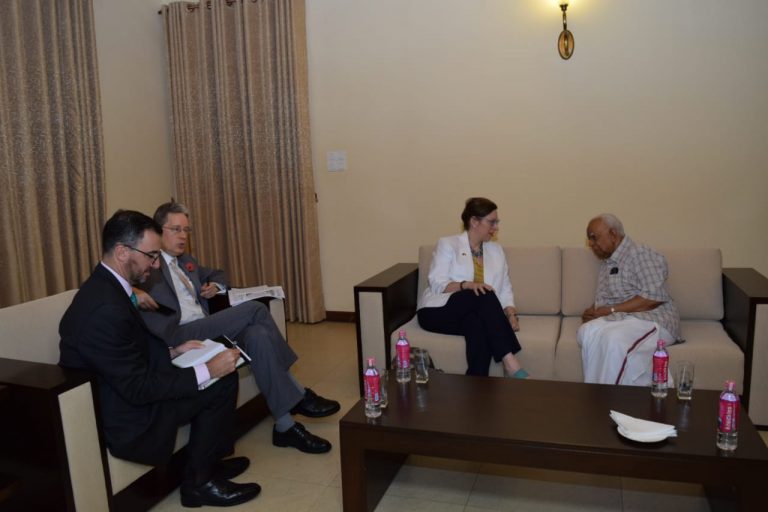
USA is committed to the implementation of UNHRC resolution on Sri Lanka, Ambassador tells Sampanthan

TNA Press Release/ 06.11.2018.

The United States for Sri Lanka Ms. Alaina B. Teplitz met with the Leader of the Opposition and the Tamil National Alliance Hon R Sampanthan today at his residence.

Briefing the Ambassador on present situation in the country, Mr. Sampanthan said, that the events that have taken place in the past week in removing the Prime Minister are unconstitutional. Further, he said proroguing Parliament for a longer period is only paving the way to legitimize what has been done in an undemocratic manner by offering various benefits to those who want to shift sides. He further stated that he had written to the Speaker to take steps to reconvene the parliament at the earliest.

Mr. Sampanthan highlighted that the government did not sufficiently address the issues faced by the Tamil people. He highlighted that on the issues of the Political prisoners, resettlement, and rehabilitation, the release of lands occupied by the armed forces, issue of missing persons the progress has been slow. He further stated inadequate delivery on these matters has caused a sense of disappointment among the Tamil people.

Mr. Sampanthan reiterated that a genuine and acceptable political resolution to the Tamil question within an undivided indivisible Sri Lanka is a must and the country will not overcome any of its problems until such a resolution is achieved. He further requested the Ambassador to keep a constructive engagement with the government with regards to its commitment to the international community and to the United Nations Human Rights Council.

The Ambassador stated that the United States Government wants the democratic process to take its place and a resolution to the current crisis must be found through the democratic process. The Ambassador further assured that the United States remain committed to the aims and the implementation of the UNHRC resolution and towards achieving lasting reconciliation in Sri Lanka.

Along with Ambassador Alaina Teplitz Deputy Chief of Mission Robert Hilton and the Political Section Chief Anthony Renzulli were also present at the meeting which lasted approximately an hour.

Political turmoil could test Sri Lanka’s ties with international community

  • The European Union said it may consider revoking Colombo’s trade privileges if the government doesn’t continue progress on human rights.
  • “Foreign governments and organisations should reconsider any economic support linked to democratic governance,” The International Crisis Group warned in a statement.

International concerns about Sri Lanka’s ongoing political crisis are growing, pushing major powers to take action.

Nearly $500 million in U.S. aid and a Japanese loan of $1.4 billion have both been put on hold amid fears about the state of democracy in Sri Lanka, the country’s ousted Prime Minister Ranil Wickremesinghe told Reuters over the weekend.

That came after the European Union said last week that it may revoke Colombo’s trade privileges if the government doesn’t continue progress on human rights and Sinhalese-Tamil reconciliation. Strife between the country’s two major ethnic groups — the majority Sinhalese and minority Tamils — underlined a brutal civil war that lasted from 1983 to 2009.

“Countries are sensitive … democratic countries have concerns,” Reuters quoted Wickremesinghe as saying with regard to his dismissal.

More than a week after President Maithripala Sirisena replaced Wickremesinghe with former president Mahinda Rajapaksa, Colombo remains in a political deadlock. Wickremesinghe, who called the move illegal, refused to leave his post, essentially leaving the country with two prime ministers.

After a period of forced recess, parliament is now due to reconvene Monday. That means members of parliament will be able to hold a confidence vote on Rajapaksa but many fear the decision could be rigged amid potential attempts to intimidate and bribe officials. Speaker of the Parliament Karu Jayasuriya announced Monday that Rajapaksa would not be accepted as the new prime minister until he proves he commands a majority in parliament, Reuters reported.

 ‘Reconsider’ economic support

“It is hard to imagine the cooperative, positive relationship with the international community continuing under a Rajapaksa government,” Jeffrey Feltman, visiting fellow at the Brookings Institution, wrote in a recent note.

While he was president from 2005 to 2015, Rajapaksa isolated Colombo from the world as a result of widespread human rights atrocities and his resistance to international investigations on war crimes. But Colombo’s global image improved in 2015 with the Sirisena-Wickremesinghe government, which was willing to work with the United Nations and address issues such as accountability and missing persons.

The International Crisis Group has called for more global pressure to punish Colombo if Rajapaksa does not receive parliamentary approval.

“Foreign governments and organisations should reconsider any economic support linked to democratic governance,” the organization said in a statement last week. “Governments should also begin to consider applying targeted sanctions against Sirisena, Rajapaksa, their families and their close associates should Sri Lanka’s constitutional coup proceed.”

The prospect of fresh violence should serve as a warning sign for Western powers.

A former strongman associated with authoritarian-style politics and communal divisions, Rajapaksa could re-ignite Tamil extremism, which could prompt Sinhalese Buddhist politicians to justify anti-minority policies, Feltman warned. It “hardly seems coincidental” that Buddhist extremist Amith Weeresinghe was released on bail just days after Sirisena appointed Rajapaksa, Feltman added.

Sri Lanka not under ‘threat’ from US-China trade tensions, says PM

Sri Lanka not under ‘threat’ from US-China trade tensions, says PM

Economic fallout

If Sri Lanka loses the support of trading partners such as the U.S., Japan and the E.U., its already vulnerable economy is set to suffer.

The Ministry of Finance on Friday announced a slew of initiatives meant to revive the economy, including lower petrol prices and reduced levies on certain agricultural commodities. The crowd-pleasing measures are likely to boost Rajapaksa’s popularity — the newly-appointed PM is a known populist — ahead of the expected parliamentary vote.

But the fiscal relief package could also strain state finances at a time when revenues are already weak, according to economists. A day before Friday’s news, Sri Lanka’s central bank warned that Colombo may miss its budget deficit target for 2018 — 4.8 percent of gross domestic product — amid lower-than-expected income collection from import duties.

That, in turn, could impact Colombo’s three-year $1.5 billion loan program with the International Monetary Fund. Under the agreement, the island nation must implement a range of reforms that include fiscal consolidation, revenue mobilization and structural reforms on state enterprise.

Given the risk of fiscal slippage under Rajapaksa, the final tranches of IMF funds may be called into question, said Kenneth Akintewe, head of Asian sovereign debt at Aberdeen Standard Investments.

Colombo also faces significant rollover risks in terms of national debt.

“Some of the biggest maturities are coming up next year so this [political crisis] is extremely bad timing for Sri Lanka,” Akintewe added.

Politically speaking, ‘a plague on both your houses’ – Kishali Pinto Jayawardene

Continuing his swift disastrous strike last Friday, President Maithripala Sirisena has taken a familiar problem of public fury with an inept and malfunctioning Government to a perilously extra-constitutional trajectory, prompting deep revulsion on the part of even those strongly critical of many follies of the United National Party (UNP).

Repercussions of the President’s actions

This step was prompted by fiendish legal advice by whom the President referred to as ‘neethi visharadayo’ (legal experts). It is safe to presume that this supposed expertise is perchance heavily influenced by pedestrian considerations of power and position rather than with the niceties of constitutional law. Chaos has been unleashed on a bewildered public as global consternation continues to rise. Harsh international repercussions seem certain if Sri Lanka remains suspended in a state of democratic limbo. Regardless of which ‘Prime Minister’ wins the day when Parliament is finally convened, this will have lasting inimical impact.

Within the country, there is only so much abuse that a beaten and battered democratic system can take. Internationally, the extreme fragility of the country’s democratic state is showcased in unflattering international headlines. All that is not to the good. But even as fury is heaped (justifiably) on the President’s head, the UNP’s part in bringing about this veritable constitutional cataclysm must be put on record. As such, it must do far more than merely apologise for putting forward Maithripala Sirisena as the common candidate in 2014/2015. This week’s flippant explanations for the ‘small mistakes’ it made will not do.

Central to this responsibility is its arrogant and secretive decision-making by a few, from unwisely expansive constitutional  reform to asinine economic policies, in complete disregard of the public mood whilst increasingly isolating and humiliating the President. Even with all the aggravation, it must not be forgotten that the President who catapulted the country into chaos last Friday was the same President who voluntarily decreased his constitutional powers in 2015. The change between then and now, is only in part due to hardening of party positions on both sides.

Factors having a bearing on the crisis

First, continuously ‘speaking down’ to a President and deliberately keeping him out of core decision-making processes, despite the fact that he held the power of prorogation of Parliament in his hands was a monumental miscalculation. Indeed, when satisfying themselves that the 19th Amendment suited its particular political chess games, its scornful assessment would have been that Maithripala Sirisena of Polonnaruwa would not have had the audacity to prorogue the House without the advice of the Prime Minister or the Speaker. But that is precisely what he did, albeit to the great detriment of the country.

The second but equally important factor impacting on the crisis is the amateurish revision of the JR Jayewardene Constitution of 1978 by a 19th Amendment full of constitutional ‘holes’, so as to speak. While the circumstances of dissolving a Cabinet and dismissing a Prime Minister are unambiguous in the English and Sinhala versions as discussed in these column spaces last week, these provisions are hedged around with clumsily phrased clauses that create unworkable situations. What we see today is a classic illustration of that unworkability, explosively aggravated when two men who remain insecure in different respects occupy diametrically confrontational political spaces and a third man (Rajapaksa) who in all fairness cannot be said to suffer from insecurity in any sense of the word, capitalises on the vacuum with typical political opportunism.

Meanwhile President Sirisena has tried to justify his tumultuous actions by recital of a long list of woes against the UNP in an address to the Nation including personal and ‘cultural’ differences. The address had a contrary effect if the President meant to justify his actions. The alleged assassination plot against the President is one illustration. Common sense dictates that  the executive President surely should have led the investigation through his handpicked state officers if he was dissatisfied about the conduct of the police, not sworn in a new Prime Minister whom he had once accused of trying to put him underground.

An extraordinary step into an unknown void

Other complaints struck a chord of popular empathy such as the sidestepping of the President in the Government’s decision making process and referencing of the Central Bank of Sri Lanka (CBSL) bond scam. I have said repeatedly in these column spaces that the UNP stands twice condemned in regard to the CBSL scandal; first by the perpetuation of the actual scam itself and secondly by its determined efforts to cover this up by parliamentarians in the ‘footnote clique’ who now protest that their constitutional rights have been violated.

But these are old complaints. A day later, the ‘yahapalanaya’ Prime Minister Ranil Wickremesinghe refuted the allegations. But taking the address by itself, was the sum total of these presidential grievances reason enough to propel such an extraordinary step into the unknown darkness of extra-constitutionalism? Surely President Sirisena knew that this would be the result, regardless of what his shadowy ‘experts’ had to say?

Enormously difficult times lie ahead. On the one hand, it is difficult to believe the promises of the Rajapaksa-led SLFP that it will reform, given the resurgence of  thuggery and violence since last Friday. On the other hand, the UNP may be advised to refrain from moralistic bombast regarding ‘sacred constitutional and legal obligations’, which it has been quick to indulge in when pressed against the wall. This rings hollow in the face of its unscrupulous manipulation of the constitutional document since 2015, its utter failure to bring corruptors of the previous regime to justice when it had the chance and the misdeeds of its own corrupt deal makers. We will not be gullible enough to fall for these wide-eyed protestations twice-over.

Core issue of constitutional propriety

Even so, the issue before Sri Lanka today is very clear. This is very simply a case of constitutional propriety of the President’s actions, not sympathy for the UNP struggling in political quicksands of its own making. That is the sole reason why protests must ensue with vim and vigour. We can only look at what is unfolding before us with disgust and proclaim ‘a plague on both your houses’ with considerable force, even as Shakespeare’s chagrined Mercutio did against the feuding families of Montague and Capulet.

The UNP and the SLFP have held Sri Lanka hostage to their ambitious games for far too long. As differentiated from India’s post-independence leaders of conscience motivated by genuine concern for the country, (despite some exceptions), here we have narrow, parochial and provincial thinking by small men with petty minds. This has degraded the land of our birth and dragged it to the depths of economic, social and political ruin.

Enough must surely be enough.

  • Sunday Times
  • Image Iromi Perera Tweeter

Sri Lanka : The Return of a Supremacist – Anura Gunasekera

Never has the truth of that  hackneyed cliche’, “ in politics there are no permanent friends  or permanent enemies, but only permanent interests”, been so aptly demonstrated than in the drama that is being currently played out in our theatre of the absurd.

In an act of unbelievable political expediency President Sirisena betrayed all the noble principles of the Rule of Law, Constitutional Democracy and Good Governance  that  he so sanctimoniously vowed four years ago  to uphold, and handed back the reins of power to the  supremacist whom he ousted;  at the risk of his life as Sirisena himself said at that time.  

Maithripala Sirisena, a colourless man with a colourless career, for a greater proportion of that  an unthreatening presence to his more ambitious colleagues, will now be remembered for ever for two epochal events, both occurring in the evening of his political life. Without those two episodes, in the normal course of events he would have faded away  as many other politicians of his calibre,  eventually to be forgotten even by his constituents.

The first event was when, in November 2014, he stood before the nation, flanked by his campaign companions and supporters and declared  his challenge to the most powerful and most charismatic politician this country has seen since Independence. In the context of the time and the nature of his opponent it was a courageous gesture and  a  moment of genuine greatness in an otherwise  singularly unremarkable life. Given the history of the Mahinda  Rajapakse operational style, the possible risk to his life was not an exaggeration. The number of Rajapakse opponents and critics who were neutralized through violent death, inexplicable disappearance, summary dismissal from public office, incarceration and expulsion or permanent flight to other countries,  represents a  compelling body of  evidence of the peril inherent in  throwing down the gauntlet at Mahinda Rajapakse.

The second event  was just a couple of days ago, when with a terse message addressed to sitting Prime Minister Ranil Wickramasinghe, he betrayed the trust of 6.2 million people and released to the land the spectre that he had once  helped to contain. With one stroke of his pen he re-launched the Rajapakse dynastic project which he himself once helped to derail. Unless something miraculous happens the project is now on track and in my view miracles do not happen. The Rajapakse cabal will not make the same mistakes again. It is not that they will reform. They will simply act with greater ruthlessness, with  excessive care and certainty, ensuring that the opposition will not rise again.

Irrespective of the arguments in support of Sirisena’s action, particularly by G.L. Peiris, that unrepentant apologist for a succession of unscrupulous rulers, the entire episode of unseating Wickramsinghe and appointing Rajapakse carries with it all the elements of a constitutional coup, secretively configured and suddenly executed, carefully hidden from the victim till the very end. The Parliament, the Speaker and the nation, which includes the many people who propelled both the victim and the perpetrator in to power, were kept in the dark. It is something that should never have happened in a robust democracy. It is exactly what happens in a typical “ banana republic”, which the Rajapakse regime helped to usher in. So far there has been no shooting, as would be normal in a banana republic, except in a parallel development  at the Ceypetco office. But, unless there is a reasonable and democratically acceptable solution to this crisis, the shooting may also soon take place elsewhere.

What Sirisena has done is unparalleled in the recent history of  a democratic entity, anywhere. In his subsequent address to the nation,  he attributed to his action  a long litany of purported misdeeds of the Prime Minister to which he also attached the cultural gulf that existed between the two of them. He stated  that Wickramasinghe conducted the business of running the country in consultation with a just few close associates of his, who belonged to a privileged class. That statement would be laughable if not for the ominous consequences that the nation will face under Rajapakse rule. Does Sirisena  seriously expect Mahinda Rajapakse to act differently or more democratically than Wickramasinghe? Under Rajapakse the country will be governed by him, in consultation with  his family and a couple of associates and friends, as was the case in the nine years of his stewardship. Of course, there will be one cardinal and singularly important difference between the two regimes. Under RW, criticism of the regime and its actions   was permitted to a ridiculously candid extent. As opposed to that extreme of freedom of expression, one has only to consider the history of dissent under Rajapakse governance. Elaboration is unnecessary.

The constitutional and legal validity of RW’s removal will continue to be debated and can be finally resolved only by a ruling of the Supreme Court, assuming that the Rajapakse juggernaut that is rapidly steamrolling the RW administration will permit the issue to be canvassed at that forum.  Mahinda Samarasinghe, over electronic media, triumphantly read out two letters, first the one  addressed by the Speaker to the Acting Attorney General seeking clarity regarding the issue, and second the  latter’s response to it. The reply appeared to be deliberately equivocal and certainly does not lay the matter to rest. As I, and I am sure most reasonable people in this country would understand it, the crucial determinant of legitimacy of governance is provided by a parliamentary majority. That I believe is the litmus test.

The prorogation of Parliament, notwithstanding all the logic attached to it by its proponents, is really a strategy to enable MR to gather, through cash purchase and any other means possible, the additional numbers he needs to legitimize an illegitimate promotion. The consolidation of Rajapakse power over the administration before reconvention of the Parliament, may eventually be an impediment to the delivery of an impartial legal opinion on the matter. The medium term objective of this constitutional coup is also to provide  Sirisena a path, as a Rajapakse lackey,  for a second presidential term,  which the UNP would have denied him.

Irrespective of the legal and constitutional arguments, Sirisena, with his precipitate action, has set in motion an unprecedented constitutional crisis, locking two men in an internecine  struggle for the prime ministerial seat and the right to govern. It has brought in to question the very validity and legitimacy  of the existing constitution. Sirisena has created the conditions  for  civic disobedience in the country and that  is an environment  in which Mahinda Rajapakse thrives. It has always been his political bread and butter. In a contest in which the quickest path to victory is the  use and abuse of power and extra-legal intimidation, coercion and paramilitary suppression, there can be only one winner.

A perfect example of the above is the violence unleashed on Rupavahini and the ITN within hours of the proclamation of MR as Prime Minister. The unambiguous threats of forcible eviction of RW from Temple Trees, delivered by Wimal Weerawansa over electronic media are  also simply  echoes of his master’s voice.

It is not the purpose of this writing to either demonize Rajapakse or to sanctify Wickramasinghe. Both are unscrupulous in different ways and equally power-hungry. The difference with RW is that physical intimidation not excluding murder, is not the preferred method of stifling dissent and enforcing personal writ. What is at stake here is not the desirability of one individual over the other as the Prime Minister of the country but the legitimacy of democratic rule in the country. That is infinitely more important than the two individuals concerned.

Under a new Rajapakse rule one has to expect certain immediate and  inevitable consequences. Firstly, there will be the dismantling of all the ongoing  investigative processes in to financial irregularities and other crimes-including politically motivated murder- committed during the previous Rajapakse regime. Selected criminals currently serving sentences are likely to be pardoned. It may not be too long before Galaboda Gnanasara exchanges his prison jumper for the robes that the Buddha sanctified and recommences his rampage against Muslims. Duminda Silva may soon be  addressing political rallies once more. The Armed Forces, the Police Department  and the Judiciary are likely to see Rajapakse favorites in crucial positions. The areas of public service which are expected to deliver impartial outcomes to the nation  will once again become willing adjuncts to  the Rajapakse project.

President Sirisena has created a situation which is pushing a country, already beleaguered by a faltering economy and massive public fraud, in to total chaos at all levels. It is his responsibility now to resolve it. In January 2015 he said that he risked his life in order to do the right thing on behalf of the nation. That is exactly what he needs to do again, despite the certain knowledge that the risk is now  of a greater magnitude. The Rajapakses do not forgive those who betray their cause; certainly not a second time.

On that eventful day four years ago, almost immediately after  Maithripala Sirisena’s victory over Mahinda Rajapakse was officially  confirmed, I received a call from a friend, once one of the most highly regarded civil servants of then Ceylon, for long   living in retirement in England. I was euphoric, as Sirisena’s win over Rajapakse represented to me, literally, the triumph of good over evil. My friend brought me down to earth with the words, “  Never place your faith  in politicians. I have, for years observed their operations at close quarters. Sirisena himself  may one day create the path for Mahinda Rajapakse to come storming back”.

Those were the exact words of  Neville Jayaweera,  Chairman and Director General of the Ceylon Broadcasting Corporation from 1967-1970 and, at different times, Government Agent, Jaffna and Vavuniya. A prophetic utterance, from a man who had seen the best and worst of politicians, in an era when most politicians were of a different breed.

Maithripala Sirisena has defined himself, irrevocably, as a man of straw. Inevitably,  it is they who are first consumed by the conflagrations that they fuel.

30.10.18

Prez Sirisena’s action both undemocratic and unconstitutional- Statement by Professionals

Statement on the Constitutional Crisis

Recent actions of President Maithripala Sirisena purporting to remove Mr. Ranil Wickremasinghe from office as the Prime Minister and the purported appointment of Mr. Mahinda Rajapaksa in his place have caused a constitutional and political crisis.

As professionals who value and defend constitutional democracy, we consider it our duty to explain to the citizens the correct constitutional position on this issue.

The Nineteenth Amendment to the Constitution is one of the success stories of the ‘100 day programme’ of the UNF-UPFA unity government. Both President Sirisena and Prime Minister Wickremasinghe jointly gave political leadership to its enactment in Parliament by a two-thirds majority. The 1978 Constitution, as amended by the Nineteenth Amendment, is the only constitutional document that should govern the actions of Sri Lanka’s President with regard to the Prime Minister.

According to the Constitution as it presently stands, once a Prime Minister is appointed, his/her office will be vacated only in limited instances i.e. resignation, ceasing to be a Member of Parliament (Article 46), OR where he is removed by virtue of the dissolution of Cabinet which will automatically occur upon the defeat of the Statement of Government Policy or the Appropriation Bill, or upon a motion of no-confidence being passed against the Government (Article 48).

As the objective of the Nineteenth Amendment was to move towards a Parliamentary democracy, the Nineteenth Amendment expressly repealed the power of the President to remove the Prime Minister that existed under provisions of the original 1978 Constitution and its 18th Amendment.

Prime Minister Wickremesinghe has not resigned or ceased to be a Member of Parliament. Neither has dissolution of Cabinet occurred (as there was no defeat of the Statement of Government Policy or the Appropriation Bill, and as no motion of no-confidence was passed against the Government).

There are suggestions that the Cabinet of Ministers stood dissolved upon the UPFA leaving the National Government. However, this argument too does not hold water. Unlike Article 48 which specifically refers to the dissolution of the Cabinet of Ministers in specified situations, the provisions relating to a National Government entail no such consequences. Thus even upon the discontinuance of a National Government (which is a matter for Parliament to decide on), the only consequence will be that the Constitutional ceiling on the number of Ministers will become operative..

Also, Mr. Ranil Wickremesinghe was appointed Prime Minister on 21 August 2015, before the National Government was formed, by the President as the Member of Parliament who in his opinion is most likely to command the confidence of Parliament after the United National Party won the highest number of seats at the General Elections held on 17 August 2015.

In any event, it would appear that the National Government continues, since the Sri Lanka Muslim Congress, which was an initial partner of the National Government, remains a partner thereof.

In the absence of a vacancy in the office of Prime Minister, the attempt by President Sirisena to remove Prime Minister Wickremesinghe and to install Mahinda Rajapaksa MP in that office Pre

The resultant constitutional crisis could most appropriately have been dealt within Parliament, by a floor test. In fact, the proper constitutional course of action would have been to have demonstrated in Parliament by vote, an absence of confidence in Prime Minister Wickremesinghe and the Government PRIOR to President Sirisena embarking on his present course of action.

However, far from permitting Parliament to resolve this issue, President Sirisena has embarked on a further undemocratic step of proroguing Parliament, thus attempting to prevent Parliament from debating and resolving the matter, and perhaps paving the way to facilitate cross-overs. As Speaker Karu Jayasuriya’s letter demonstrates, the prorogation was proclaimed in breach of Parliamentary traditions, as the Speaker had not been consulted prior to the prorogation.

Leaving this crucial constitutional issue unresolved in Parliament will result in further aggravating the political, economic and social crisis.

We therefore call upon:

  1. President Sirisena to forthwith revoke the Prorogation, to facilitate the immediate resolution of this crisis through Parliament;
  2. Speaker Karu Jayasuriya to forthwith convene Parliament, to facilitate the immediate resolution of this crisis through Parliament;
  3. All government leaders and MPs to abide by, and not to transgress, the principles and provisions of the Constitution.
  4. All political leaders, to ensure that violence and unrest are prevented;
  5. All Members of Parliament, to ensure that they vote in accordance with the mandate the People have granted them, and not in consideration of financial or other benefits offered;
  6. All public servants, to ensure that they do not obey any instructions granted by unconstitutionally appointed persons, and that they uphold the Constitution and the rule of law;
  7. The Inspector General of Police and the Armed Forces, to ensure that in carrying out their duties, they act in a non-partisan manner, and strictly in accordance with the Constitution and the rule of law.

Prof. Jayadeva Uyangoda, Professor Emeritus, University of Colombo

Prof. Vijaya Kumar, Professor Emeritus, University of Peradeniya

Prof. Kumar David, Professor Emeritus, University of Hong Kong

Prof. Gamini Keerawella, Professor Emeritus, University of Peradeniya

Prof. Navaratne Bandara, Retired Senior Professor, University of Peradeniya

Prof. Jayantha Seneviratne, University of Kelaniya

Prof. Sumathy Sivamohan, University of Peradeniya

Prof. Upul Abeyratne, University of Peradeniya

Prof. Chandraguptha Thenuwara, University of the Visual and Performing Arts

Dr. Upatissa Pethiyagoda

Upul Jayasuriya, President’s Counsel

J.C. Weliamuna, President’s Counsel

Dr. Jayampathy Wickramaratne, President’s Counsel

Nissanka Nanayakkara, President’s Counsel

Rajan Philips, Political Critic

Dr Lionel Bopage

Dr. Ananda Galappatti

Lal Wijenayake, Attorney-at-Law

Tissa Jayatilaka

Chandra Jayaratne

Dr. Paikiasothy Saravanamuttu

Dr. Asanga Welikala, University of Edinburgh

Ameer Faaiz, Attorney-at-Law

Pujitha De Mel, Lecturer, University of Colombo

Mrs. Chamantha Weerakoon, Attorney-at-Law

Danesh Casie Chetty, former diplomat

Lux Jothikumar, Attorney-at-Law

Viran Corea, Attorney-at-Law

Ravi Jayawardana, Attorney-at-Law

Thishya Weragoda, Attorney-at-Law

Sri Lanka: From uncertainty to crisis – Jayadeva Uyangoda

Whatever turn developments may now take, Sri Lanka’s fragile process of democratic recovery is in peril.

Last Friday, Sri Lanka’s President Maithripala Sirisena sacked Prime Minister Ranil Wickremesinghe and appointed Mahinda Rajapaksa, his political rival until the day before, as the new Prime Minister — a surprising move that Mr. Sirisena made in order to resolve a deepening political dispute between himself and Mr. Wickremesinghe. But this act has only pushed Sri Lanka into an unprecedented constitutional crisis, beginning a potentially dangerous phase of an on-going three-cornered power struggle among three leaders.

At the centre of the crisis is the lack of clarity as the new Prime Minister seems to have been appointed without a constitutionally valid vacancy for the position.

Crux of the issue

The constitutional provision that Mr. Sirisena has cited in the official letter to Mr. Wickremesinghe does not grant the President authority to remove a Prime Minister from office. Section 42(4) of the Constitution merely enables the President to appoint a PM. The President has taken the position that since he is the appointing authority, he also has the implicit power to sack the PM. The PM is not a public servant who can be sacked by the appointing authority at his will. It is a constitutional office with protection from the executive. This is the crux of the constitutional dispute.

The entire operation of altering the composition of the government seems to have been executed in a great hurry and in secrecy. There is also lack of clarity whether Mr. Sirisena’s letter (removing Mr. Wickremesinghe) had actually reached him by the time Mr. Rajapaksa was sworn in. This has led some commentators to call it a ‘constitutional coup’.

The position by Mr. Wickremesinghe aggravates the seriousness of this constitutional dispute. Dismissing the constitutional validity of the presidential action, he has argued that he still commands a majority in Parliament. His line of argument is that only Parliament has the constitutionally sanctioned authority to decide whether he could continue in office as PM or not. It also suggests that as long as there is no no-confidence motion passed in Parliament against him and the cabinet, his position as PM cannot be invalidated by the President at his will.

Mr. Wickremesinghe has also cited the fact of having defeated a no-trust motion brought against him a few months ago, and that situation, of Parliament’s majority expressing faith in him, remaining unaltered.

The argument seems to have derived its salience in the context of the 19th Amendment to Sri Lanka’s Constitution, passed in 2015 under the joint political leadership of both Mr. Sirisena and Mr. Wickremesinghe. It curtailed powers of the President under the 1978 Constitution (the original) as well as the 18th Amendment passed in 2010. Among the presidential powers taken away by the 19th Amendment, which is valid, is the one pertaining to the President’s powers over the PM.

The 19th Amendment, which created a dual executive, made the PM’s position secure from the arbitrary actions of the President. Thus, the office of the PM falls vacant only under limited circumstances. Death, voluntary resignation, loss of support in Parliament, rejection by Parliament of the budget, and ceasing to be an MP are these circumstances. Sacking by the President is certainly not in this list.

By this change, the 19th Amendment has also restored the Westminster framework of relationship between the head of state, the PM, and Parliament.

All these make the constitutionality as well as democratic legitimacy of the actions of Mr. Sirisena less than clear.

An argument put forward on behalf of the President is that when the United People’s Freedom Alliance, which was a partner in the so-called unity government, informed the Speaker last Friday that it was leaving the ruling coalition, the cabinet automatically stood dissolved, thereby creating a vacancy for the office of the PM. This is not an argument derived from any explicit provision of the Constitution. It is merely a political argument. What it does is no more than confirm that the composition of the coalition government was altered. It does not automatically lead to the loss of constitutional validity of the cabinet and the position of the person holding the office of the PM.

No clarification

Mr. Sirisena’s address to the nation on Sunday did not clarify the constitutional issue at hand. He cited political and personal reasons why he could not partner with Mr. Wickremesinghe as the PM. But his assertion that he acted fully in accordance with the Constitution is only a claim. It awaits clarification. What is in dispute is not the total breakdown of relationship between the two leaders, leading to a collapse of their coalition. What is in doubt is the constitutionality of a series of actions by Mr. Sirisena on Friday. And if they are valid at all, they set a bad precedence for future constitutional governance in Sri Lanka. Contrary to the letter and spirit of the 19th Amendment, no PM will be secure in his/her position against arbitrary dismissal by the President. These circumstances also warrant judicial intervention to resolve the constitutional doubt.

Amidst this, the political dispute between the new coalition (Sirisena-Rajapaksa) and the Wickremesinghe led-United National Party (UNP) has now reached a stage of open confrontation. Mr. Wickremesinghe has refused the leave the office of PM as well as the official residence in Colombo. Speaker Karu Jayasuriya has written to Mr. Sirisena demanding that the rights and privileges of Mr. Wickremesinghe be protected, “until any other person emerged from within Parliament as having secured the confidence of Parliament”. The Speaker has implicitly acknowledged that Mr. Wickremesinghe is still the constitutionally legitimate PM.

Obviously, Mr. Wickremesinghe and the UNP want to take the battle to Parliament where the UNP feels that it can secure majority support. Meanwhile, Parliament has been prorogued by the President till November 16. As the numbers stand at present, Mr. Rajapaksa does not enjoy a majority in Parliament. The time left ahead will give Mr. Sirisena and the new PM enough time and space for horse trading. Ranged against this formidable combine that has been consolidating its grip on state power and institutions since Friday, are Mr. Wickremesinghe and the UNP who have only limited options — testing his floor strength, bringing a motion against Mr. Rajapaksa, and political defiance. He can also go to the Supreme Court.

If the UNP does so, the Supreme Court, which has been on a path to regaining its institutional independence and autonomy, will be called upon to adjudicate over a very sensitive power struggle among top politicians. The days ahead could be trying time for the judiciary as well.

The other side

Meanwhile, in planning his next moves for political survival, Mr. Wickremesinghe should also realise that he is partly to blame for the political imbroglio. His inability to establish a stable working relationship with the President to run the coalition government, casual disregard for the popular mandate he and Mr. Sirisena jointly won in 2015 for corruption-free governance and politics, lackadaisical attitude to constitutional reform and reconciliation, and gross neglect of popular demands for better economic governance have severely eroded his popular standing.

The biggest political irony is this. The collective failure of Mr. Sirisena and Mr. Wickremesinghe to be faithful to the 2015 mandate has now brought Mr. Rajapaksa back to power on the invitation of one party in a coalition which dislodged him from power.

Whatever turn the crisis may take, Sri Lanka’s fragile process of democratic recovery is in peril.

Jayadeva Uyangoda is Emeritus Professor of Political Science, University of Colombo, Sri Lanka.

The Elders call on Sri Lanka’s leaders to uphold constitutional law

The Elders express grave concern at the situation in Sri Lanka following President Maithripala Sirisena’s unconstitutional decision to dismiss Prime Minister Ranil Wickremesinghe and suspend Parliament.

“President Sirisena must stand by his past commitments to deliver peace, justice and reconciliation to his people – all of which can only be achieved by strict adherence to and respect for the constitution.” – Hina Jilani

The Elders today expressed their grave concern at the unprecedented situation in Sri Lanka following President Maithripala Sirisena’s unconstitutional decision to dismiss Prime Minister Ranil Wickremesinghe and suspend Parliament.

They called on President Sirisena to immediately allow Parliament to reconvene as a first step to resolve the country’s political and constitutional crisis.

The Elders urged all the country’s political leaders to act in strict accordance with the rule of law and show respect for human rights and democratic principles, refraining from any actions that could inflame political tensions and cause more violence.

Gro Harlem Brundtland, Acting Chair of The Elders and former Prime Minister of Norway, said:

“Sri Lanka is facing an unprecedented constitutional crisis which must be urgently resolved by peaceful and legal means. The country has suffered so much from years of conflict and human rights abuses, and cannot afford reckless political manoeuvres. I urge President Sirisena to act in the interest of all Sri Lankans by respecting democracy and constitutional norms.”

The Elders warned that further unconstitutional actions risked jeopardising the fragile reconciliation and redevelopment processes that Sri Lanka has undertaken following decades of civil war. Trust in state institutions could be seriously harmed if the constitution is violated by the head of state.

Lakhdar Brahimi, Elder, former Foreign Minister of Algeria and UN diplomat, said:

“In all its years of conflict and anguish, Sri Lanka has never experienced such a serious constitutional crisis. The country’s leaders must abide by its traditions of constitutional law and parliamentary democracy and govern with transparency, accountability and full respect for human rights.”

Hina Jilani, Elder and Pakistani human rights advocate, added:

“This is a moment of acute concern for all who are committed to the rule of law and democracy. President Sirisena must stand by his past commitments to deliver peace, justice and reconciliation to his people – all of which can only be achieved by strict adherence to and respect for the constitution.”

ENDS


For media inquiries, please contact William French, Head of Communications at The Elders (+44 7795 693 903) or email: [email protected]

Sri Lanka’s constitutional crisis : ICG lists out steps for international community to consider

While Sirisena and Rajapaksa may currently have the upper hand, the outcome of the power struggle is still undecided. Influential governments and international institutions should support those who are peacefully challenging Rajapaksa’s appointment from within the country by sending strong messages that the unconstitutional move will bring significant costs for Sirisena, Rajapaksa and the Sri Lankan state. They should continue to call on Sirisena to reverse his decision and allow parliament to reconvene with immediate effect, follow the constitutionally sanctioned process and allow the two sides to test their support through a vote of no confidence.

The U.S., EU, UK, Australia, India and all governments with influence should urge the military and police to enforce the law fairly and without bias and refrain from cracking down on peaceful protest by the UNP or citizens’ groups, as many fear is possible. They should make clear that they will reduce or end training programs and other forms of cooperation with Sri Lanka’s military and police if those bodies actively back Rajapaksa’s power grab.

Foreign governments and organisations also should reconsider any economic support linked to democratic governance. The EU should make clear that preferential trade benefits, only restored to Sri Lanka in 2017 thanks to its improved compliance with human rights treaties, could be lost again should Rajapaksa retain the premiership on the basis of an unconstitutional change of power.

The U.S. should immediately suspend the process for final approval of $450 million in economic development funding from the Millennium Challenge Corporation, a program designed in part to reward good governance. Governments should also begin to consider applying targeted sanctions against Sirisena, Rajapaksa, their families and their close associates should Sri Lanka’s constitutional coup proceed.

 An unconstitutional change of power puts at risk Sri Lanka’s democracy itself. 

A reborn Sirisena-Rajapaksa alliance with illegitimate beginnings will increase concern among some member states of the UN Human Rights Council when it considers Sri Lanka’s situation in March 2019. Many governments on the council are already unhappy with the limited progress Sri Lanka has made in implementing the reforms stipulated in the Council’s 2015 resolution on reconciliation and accountability. This is particularly true with regard to Sri Lanka’s failure to investigate credible allegations of war crimes and grave human rights abuses that took place during Rajapaksa’s presidency, including by both government forces and the Tamil Tigers, whose separatist military campaign was defeated in May 2009. With a Rajapaksa-led government likely to scrap most, if not all, of the reforms the Sirisena-Wickremesinghe government initiated, Council member states should commit to working toward a new resolution that will maintain its oversight role and continued reporting by the Office of the High Commissioner for Human Rights, which will otherwise expire in March 2019.

Domestic and international resistance to Sri Lanka’s change of government is not about rescuing Ranil Wickremesinghe and the UNP. Their many mistakes over the past three and a half years have directly contributed to the difficult situation they face. But much more is at stake than the relative power of Sri Lanka’s different political parties. An unconstitutional change of power puts at risk Sri Lanka’s democracy itself, which, while deeply flawed and regularly failing to represent and protect ethnic and religious minorities, nonetheless has provided an important safety valve for conflict over the decades. To prevent Sri Lanka’s descent into a darker future, and to limit the risks of violence and lasting political instability this would bring, urgent action from within and outside the island is needed.

Brussels, 31 October 2018

Read the full report here 

Sri Lanka AG signals illegal sacking of PM 

Image: Protest in Colombo, 30 Oct 2018.

ECONOMYNEXT – Sri Lanka’s Attorney-General refusing to respond to Speaker Karu Jayasuriya’s query about the legality of Prime Minister Ranil Wickremesinghe’s sacking is seen by legal observers as the clearest sign that he does not consider it constitutional.

Soon after President Maithripala Sirisena dismissed Premier Wickremesinghe on Friday and followed it up a day later with a 20-day suspension of parliament, Speaker Jayasuriya sought Attorney General (AG) Jayantha Jayasuriya’s opinion.

In a widely expected move, the Attorney General Jayantha Jayasuriya told the Speaker that he will not give an opinion on who is the legitimate prime minister.

“I have considered the questions set out in your aforesaid letter,” AG Jayasuriya said in his letter released to the media. “Having regard to the role of the Attorney general under the constitution, I am of the view that expressing an opinion on the said questions would be deemed inappropriate.”

The AG’s letter written is legalese and in English it means he can’t offer an opinion that contradicts the position taken by his boss, the President of the republic. Besides, in future litigation, the AG will be compelled to represent the president. The AG’s letter is a major victory for Wickremesinghe and should bolster his campaign to get the parliament suspension lifted soon, legal observers say.

After last weekend’s tumultuous events in Colombo, the AG’s staff were preparing a response to the Speaker even before AG Jayasuriya returned to the island from a trip overseas.

After poring extensively over constitutional provisions, case law and parliamentary proceedings setting up the unity government, the department was unable to come up with a constitutional justification for the President’s action.

The AG’s department was in a predicament. By statute, they are expected to defend the actions of the president and appear in court on behalf of the state, therefore the department could not issue an opinion trashing the president in public.

“By not responding to the Speaker’s query, the department is signalling that it does not agree with the president’s stand,” one legal observer said. “If they supported the actions of the president, there would have been no problem in issuing a statement straight away.”

It is understood that the AG decided not to make his stand known because, eventually, he would be expected to defend the President’s position however much he disagreed with it.

Besides, the AG’s department was not consulted by the president before sacking Wickremesinghe, although the president repeatedly declared that his actions followed consultations with unspecified legal experts.

While AG Jayasuriya was away, Acting AG Dappula de Livera responded to a query from the Speaker, according to Mahinda Samarasinghe who disclosed the fact at a press conference on Tuesday.

The Speaker had asked the AG about the constitutionality of the controversial actions already taken by the President.  De Livera sidestepped the issue. His response was a brief e-mail referring to the fait accompli  — the sacking of Wickremesinghe and the appointment of Mahinda Rajapaksa through two gazette notifications.

He did not give an opinion, but merely pointed to Article 48 (1) of the constitution which discusses the only three circumstances under which a new Prime Minister could be appointed – i.e. when the incumbent resigns, dies or ceases to be a member of parliament.

The circumstances of removing Ranil Wickremesinghe did not fall within any of the situations envisaged by Article 48 (1). (COLOMBO, October 31, 2018 – Updated with AG’s letter)