Home Blog Page 97

A fight to reset Sri Lanka’s constitutional clock – Kishali Pinto Jayawardena

As the core of Sri Lanka’s Democratic Socialist Republic implodes in multiple critical ways today, it cannot be said that we were not forewarned.

For not only President Maithripala Sirisena but also each and every one of us must abide by a fundamental truth underlying the legal order. The Constitution cannot be selectively applied because we happen to like someone or dislike another. If this is not recognised, we are condemned to unceasingly wander in a weary cycle of constitutional attrition, much like the bewildered rat in the cage.

Selective constitutional propriety

There is a particular context to that warning. A bare eight months into office in 2015, the President addressed the nation before television cameras stating that even if former President Mahinda Rajapaksa’s faction of the Sri Lanka Freedom Party was successful in obtaining a majority at the pending parliamentary election, he would not appoint him as Prime Minister. Voices of reason should have been aghast at this proclamation. It was an affirmation in no uncertain terms that constitutional propriety will yield to a visceral reaction of whom the President felt should be suitable or not to appoint as Prime Minister.

But few raised their eyebrows. In fact, many applauded. Why? Because a hated and feared Rajapaksa was at the receiving end of that presidential diatribe. It was on that same reasoning that many clapped and cheered when earlier that same year, a Chief Justice who should have been properly impeached for misbehaviour in office was declared by a Presidential letter ‘never to have been in office’. As pointed out in these column spaces, that was an assessment that should have been made by Court, not by executive fiat. Yet, this was justified, supported and even urged by those who wax eloquent (then and now) on constitutional propriety.

Even as members of the black-coated fraternity strode up and down Hulfsdorp’s streets bright-eyed and bushy-tailed, demanding the Chief Justice’s summary ouster, I remember receiving a phone call from a colleague who asked me only half in jest, as to why I was not joining the ‘yahapalanaya’ melee. My response was these disastrous precedents will be rued once triumphalism following Rajapaksa’s defeat subsided.

An ugly history of subversion

Now as 2018 draws to a close, it is cold comfort to be proven right. Prodigiously infantile if not ‘instrumental’ constitution-making has reaped its bitter harvests. The removal of a UNP Prime Minister by a letter of the President has been effected in much the same manner. Putting the blame on an eccentrically manipulative Presidency is the easy way out. Instead, the responsibility is much wider. It pervades beyond the political sphere, as uncomfortable as that truth may be. This is something that Sri Lanka’s young democracy fighters lining Colombo’s streets and boulevards must remember.

That said, cynics who grumble that this is merely the continuation of a long history of constitutional subversion are only half right. Both the 1972 and 1978 Constitutions were instrumentally engineered to suit political ends. In that ugly history, the 17th Amendment stands as the one clear exception where constitutional objects were true to their aim. The 19th Amendment was a pale shadow of that steadfastness. For those who would jib at this castigation, a thorough reading of the constitutional documents is recommended.

One major illustration is the Constitutional Council devised to mediate appointments to key public posts and independent commissions. Its 17th Amendment version insisted on a majority of civil society members. This was revised in the 19th Amendment which tilted that balance in favour of politicians. To be fair, the 19th Amendment did away with the authoritarian overreach of the Rajapaksa backed 18th Amendment brazenly approved by the Supreme Court of the day. But that does not excuse this Amendment being shot through with multiple internal contradictions and inconsistencies.

Basic questions in issue

An excellent example concerns the dissolution of Parliament this Friday. This came four short days before a sitting where a floor test to determine the majority in the House would have been inevitable. Proponents of the presidential move rely on Article 33 (2) (c) which gives general power to the President to ‘summon, prorogue and dissolve’ Parliament. Opponents say that this is contrary to Article 70 (1) of the Constitution which reiterates this power but specifically ‘provides’ that Parliament cannot be dissolved before the passing of four and a half years, absent approval of a two-thirds majority in the House. On a plain and simple reading, the constitutional text inclines towards the primacy of Section 70 (1).

Even so, a basic question arises. Earlier, the power of dissolving Parliament was simply and unambiguously contained in Article 70 of the 1978 Constitution (Section 70) with provisos as to time periods that were thereafter amended. But a ridiculously tautologous general power of the President to dissolve the House was brought also into Section 33(2)(c) through the 19th Amendment, piling one folly upon another and enabling this rich confusion presently gripping the nation.

In the most profound of ironies, it is this Section that is cited by admittedly devious legal minds to justify the President’s act (‘Country in anarchy; President can dissolve Parliament, Sarath N. Silva, Sri Lanka Mirror, 08.11.2018). Interestingly it is contended that Section 33(2)(c) had been inserted following the Determination of the Supreme Court on the 19th Amendment when a clear reading of that Determination shows that very much not to be the case.

In the eye of a storm

But constitutional drafting errors aside, what is happening now is infinitely worse than at any time in the past. Rash actions by President Sirisena which are entirely devoid of remorse add to the sum total of historical abuses by the Office. An election to bring in the same set of rogues in whatever configuration is pointless. Indeed, a wildly unpredictable President may well dismiss the winner of that election as well if the outcome is not to his liking. His appeal to public officers to perform their duties regardless of political conflict is quite nonsensical. Truly we are in the eye of a storm that has the potential to strangle Rule of Law protections even as they are being slowly and and hesitantly rejuvenated.

The popular struggle must be to reset Sri Lanka’s constitutional checks and balances and reject this joke of a monstrous kind perpetuated by all three men, President Sirisena, former President Mahinda Rajapaksa and Prime Minister Ranil Wickremesinghe. To safeguard the credibility of this movement, it must studiedly keep itself aloof from the UNP and the SLFP. The discarding of the Executive Presidency must be a prime aim along with eschewing transferral of those powers to an equally authoritarian Prime Minister.

For now, it will be up to the judiciary to fulfill its role of protector of the Constitution. It is the nation’s hope (against hope?) that this task will be taken to heart in the full and awful solemnity that it demands.

(Sunday Times)
U.S. and others denounce dissolution of Sri Lanka parliament as undemocratic

Image: Civil groups have been protesting the unconstitutional move by President Sirisena since 27th Nov.
(Reuters) – Sri Lanka President Maithripala Sirisena’s decision to dissolve parliament, worsening an already major political crisis, has drawn criticism from Western powers, including the United States and Britain.

Sirisena dissolved parliament on Friday night, only five days before it was due to reconvene, but a new cabinet he installed was in danger of losing a vote of no confidence. Sirisena also called a general election for Jan. 5.

The president triggered a power struggle when he sacked prime minister Ranil Wickremesinghe late last month and appointed the island’s former leader, Mahinda Rajapaksa, a pro-China strongman defeated by Sirisena in an election in 2015, in his place.

Sirisena’s rivals are set to challenge his decision, which they describe as illegal and unconstitutional, in the Supreme Court on Monday.

The U.S. Bureau of South and Central Asian Affairs said in a tweet that the United States was “deeply concerned by news the Sri Lanka Parliament will be dissolved, further deepening the political crisis”. It said democracy needed to be respected to ensure stability and prosperity.

Mark Field, the British minister of State for Asia and the Pacific, tweeted his concern about the dissolution of parliament days before it was due to be reconvened.

“As a friend of Sri Lanka, the UK calls on all parties to uphold the constitution and respect democratic institutions and processes,” Field said.

Canada’s Foreign Policy twitter feed said that it was “deeply concerned” about the decision and referred to the risks to reconciliation work after the nation’s civil war.

“This further political uncertainty is corrosive to Sri Lanka’s democratic future and its commitments on reconciliation and accountability,” it said.

Australian Minister for Foreign Affairs Marise Payne expressed both concern and disappointment in a statement, saying the move “undermines Sri Lanka’s long democratic tradition and poses a risk to its stability and prosperity”.

Sirisena has said he fired Wickremesinghe because the prime minister was trying to implement “a new, extreme liberal political concept by giving more priority for foreign policies and neglecting the local people’s sentiment”.

“This further political uncertainty is corrosive to Sri Lanka’s democratic future and its commitments on reconciliation and accountability,” it said.

Australian Minister for Foreign Affairs Marise Payne expressed both concern and disappointment in a statement, saying the move “undermines Sri Lanka’s long democratic tradition and poses a risk to its stability and prosperity”.

Sirisena has said he fired Wickremesinghe because the prime minister was trying to implement “a new, extreme liberal political concept by giving more priority for foreign policies and neglecting the local people’s sentiment”.

“We will show that we have the parliament majority and we will show that the dictator president has dissolved a government which had a majority in the parliament,” he told reporters.

They were supported by the Tamil National Alliance, the main party representing ethnic Tamil groups in parliament, who said they too will petition the Supreme Court against the dissolution of the house.

“This is a clear violation of the constitution. The president can’t do this,” M.A. Sumanthiran, a spokesman for the alliance, told Reuters.

India and the West have raised concerns over Rajapaksa’s close ties with China. Beijing loaned Sri Lanka billions of dollars for infrastructure projects when Rajapaksa was president between 2005-2015, putting the country deep into debt.

Wickremesinghe refused to vacate the official prime minister’s residence saying he was the prime minister and had a parliamentary majority.

Before he signed the papers dissolving parliament and calling the election, Sirisena appointed allies of his and of Rajapaksa to cabinet positions.

One of them said Sirisena was right to order an election to end the political crisis. Dinesh Gunawardena, a newly appointed urban development minister, said the president had handed the country back to the people.

“It is the people’s right to vote. We have gone before the people. No force can interfere. The people’s mandate is supreme,” he said.

Independent legal experts have told Reuters that parliament could be dissolved only in early 2020, which would be four-and-half-years from the first sitting of the current parliament. The only other legal way would be through a referendum, or with the consent of two thirds of lawmakers.

Given those views, it was not immediately clear how Sirisena is on legal safe ground by dissolving parliament, though his legal experts have said there are provisions for him to do so.

Additonal reporting by Tom Westbrook in Sydney; Editing by Martin Howell, Sanjeev Miglani

Courtesy of Reuters.

Sri Lanka: Desperate dissolution


In an act that smacked of political desperation after it became evident his party may not be able to show majority in the House, President Maithripala Sirisena yesterday dissolved Parliament with elections likely to be held on 5 January.

The Gazette, which was sent by the Attorney General’s Department on Friday evening, was signed by President Sirisena, confirmed a top Minister to Daily FT. The nomination period will be from 19 November to 26 November, according to the Gazette. The new parliament will meet on 17 January 2019. Earlier in the day, the President also issued a Gazette bringing the Government Printing Department under his preview, triggering widespread speculation of a dissolution.

“According to election regulations, which gives three weeks for the Election Commissioner to call for nominations and another five to eight weeks to announce the date for elections, we can speculate polls will be held in early January,” the Minister said.

Upon being notified of the snap decision to dissolve the House, top members of the United National Party (UNP) convened for an emergency meeting to strategise on the next possible course of action. It is also possible the UNP will seek the intervention of the Supreme Court, sources said.

UNP Spokesman Harin Fernando was irate about the President’s decision and insisted it was “undemocratic and unconstitutional”.

“There is now no point in calling this unconstitutional because the President does not know what the Constitution is. The President does not understand the repercussions and the impact his actions may have on the country,” he said.

Earlier in the day, UNP member Dr. Harsha de Silva heavily criticised a possible move by the President to dissolve Parliament, insisting it is a violation of the Constitution.

“Heavy speculation President Sirisena will dissolve Parliament tonight. I doubt he will go that far to tear our Constitution to pieces. If he does, then he might as well remove the word ‘Democratic’ from the official name of our country,” tweeted UNP politician Dr. Harsha de Silva. “It is crystal clear in the Constitution that 150 MPs must seek its dissolution as per the 19th Amendment.”

Janatha Vimukthi Peramuna (JVP) Propaganda Secretary Vijitha Herath criticised the dissolution as unconstitutional and said the Elections Commission has power to reject this order and seek an opinion from the Supreme Court.

“The dissolution is the second time the Constitution has been violated by the President, and the reason for this is because he does not have the required 113 majority. By doing this, he has pulled the country into an abyss. For the first time in the history of this country, a President has violated the Constitution of this country and called for an election.”

“We will wait and see what action the Elections Commission takes,” he added.

Elections Commission Chairman Mahinda Deshapriya told Daily FT that he will have to immediately summon the Commission once the Gazette is issued.

“We are like the fire brigade, ready at any given time,” he quipped.

The latest move will nullify efforts by Speaker Karu Jayasuriya to conduct a vote to decide the majority in Parliament, which was expected on 14 November. Several countries, including the European Union and Australia, had issued statements calling for the vote to be held on the same day despite numerous SLFP voices insisting that business of Parliament must be held on a different day to the President’s Throne Speech. They quoted precedent as a reason but Jayasuriya had indicated that he was ready to dismiss Standing Orders to hold the vote.

Dissolution of Parliament was announced after President Sirisena filled the last seats of his Cabinet, mostly from members of his own party after the spate of crossovers stopped. Media Minister Keheliya Rambukwella acknowledged to reporters on Friday afternoon that UPFA does not have the required members to make up the 113 seats in Parliament.

The dissolution called by President Sirisena is likely to deepen political uncertainty in Sri Lanka and have a negative impact on the economy, which was readying to go to international capital markets to build buffers to repay about $ 3 billion in 2019 and strengthen reserves to control a depreciating currency. The rupee has depreciated an estimated 14% so far this year. Moody’s, releasing a statement last week, said the political uncertainty was a credit negative for Sri Lanka and warned that it could face refinancing challenges.

The dissolution of Parliament was described as the latest in a series of undemocratic acts by Sri Lanka’s politicians by Political Analyst Kusal Perera.

“9 January 2015 created the precedence for the President to use Constitutional provisions to establish Governments of his choice irrespective of the people’s mandate. No point in us calling the latest move an unconstitutional act as this started three years ago. If we want good governance, we should establish democracy and strengthen it,” he said.

By Chathuri Dissanayake and Uditha Jayasinghe/FT

Commonwealth Parliamentary Association (CPA) Executive Committee statement on Sri Lanka

The Executive Committee of the Commonwealth Parliamentary Association (CPA), currently meeting in London, has noted with concern the recent political developments in Sri Lanka. The CPA notes the announcement that Parliament will be reconvened on 14 November and expresses hope that the situation can be resolved at that time.

The CPA asserts the importance of upholding the rule of law as well as the essential role of the Parliament of Sri Lanka, as defined in and protected by the Constitution of Sri Lanka.

In making this statement, the CPA refers to the Commonwealth Charter, adopted by all Commonwealth member states in 2012. The Charter states that “governments, political parties and civil society are responsible for upholding and promoting democratic culture and practices.”

The CPA also refers to its Recommended Benchmarks for Democratic Legislatures which state as follows: “Reinforcing the belief that effective Parliaments are one of the principal institutions of any functioning democracy, [the Benchmarks] provide a minimum standard and a guide on how a Parliament should be constituted and how it should function. The Benchmarks are therefore fundamental to the wider values and principles of the Commonwealth Charter.”

-Ends-

Updated 8 November 2018.


The Second Coming of Sri Lanka’s Mahinda Rajapaksa – Rajesh Venugopal

In Sri Lanka, it’s yesterday once more. Mahinda Rajapaksa and his family are back in charge. For those who are very young, or with very short memories, the experience of the last few days will serve as a quick explainer of the past, and a guide to the potential future.

Elected MPs have been purchased like cattle, the media has been intimidated and cowed, and the constitution is subverted and creatively re-interpreted on a daily basis, to serve the whims and convenience of the rulers. The majority community is equated to the country as a whole, and its insecurities stoked and inflamed to win consent for this illegality, while the minorities who are targeted by this process are left insecure and anxious. In the north and east, those who have been brave enough to hold vigils, speak about their missing, or to memorialise the dead are left vulnerable and exposed to an emboldened securitocracy waiting for the right signal to spring back into action.

President Maithripala Sirisena’s stealthy dismissal of Prime Minister Ranil Wickremasinghe on 26 October, 2018 has triggered an extraordinary political crisis, and has set the stage for a prolonged period of instability and even worse.

A predictable cast of characters: the brothers, corrupt cronies, flattering sycophants, inflammatory monks, lesser demagogues, fake hunger-strikers, habitual quoters of Gramsci, disgraced public officials, and ex-Tamil paramilitaries, have all crawled back out of the woodwork to remind everyone just how egregious, malevolent, chauvinistic and corrupt the Rajapaksas were and will be.

Shortly after what is misleadingly referred to as a ‘constitutional coup’, the President and his newly appointed Prime Minister appeared to have woken up to the reality that their actions were constitutionally invalid.

The President simply does not have the authority to dismiss a Prime Minister in this manner. That power was expressly removed by the 19th amendment to the constitution, passed in 2015 a few short months after Sirisena’s own election, and which he himself along with his faction of MPs campaigned for and helped to bring into being.

In other words, this wasn’t a ‘constitutional’ coup at all. It was in reality an unconstitutional seizure of power that has no validity

Regardless, Sirisena and Rajapaksa ploughed on, and took charge of state institutions, under the assumption that the political crisis and instability they had triggered can be settled in parliament through a show of strength.

A parliamentary majority and a vote of confidence for the newly appointed Prime Minister would infuse them with authority, bring post-hoc legitimacy to their illegal seizure of power, and dismay the opposition and public at large into silence and passivity. However, this too, did not go according to plan, and the President apparently came to learn after the fact that Rajapaksa did not have the requisite majority and would struggle to find one, and would need time.

With no easy option in sight, an increasingly desperate Sirisena doubled down, and prorogued parliament for almost three weeks in the hope that it would give Rajapaksa adequate time needed to bribe opposition MPs to cross-over. After an intense period of negotiation, parliament is now set to be convened on 14 November.

Since then, a string of MPs have crossed over, walking the walk of shame to accept the offer of ministerships under Rajapaksa. This process has revealed, among other truths, that the going price for an MP is now in the hundreds of millions of rupees (in the millions of US dollars), and is payable in foreign currency in London.

One brave MP even recorded and made public the fateful phone conversation making that offer and inducing him to cross the floor. Another MP who crossed over has since crossed back, and has since apparently fled to London. The Sri Lanka Muslim Congress’s leader took the precaution of dispatching all seven of its MPs out of the country in the midst of the crisis to perform Umrah in one group together, and to focus their minds on matters more spiritual in nature.

It actually remains to be understood why exactly Rajapaksa ever agreed to this coup and why he found it to be in his political interest. Left to itself, the yahapalanaya project of ‘good governance’ was already paralysed and crumbling. The UNP-led government was losing popularity with each passing day and would have died a natural death at the polls in 2020.

Sirisena himself was fast becoming politically irrelevant, and his remaining parliamentary supporters could, with time, have lapsed back into the Rajapaksa fold. Mahinda, or his chosen family anointee could easily, with a little patience, have sat back and won the presidency and parliament fair and square in little over a year. Instead, the coup has now possibly given the UNP and Ranil Wickramasinghe an undeserved life-line.

As Sri Lanka’s political establishment heaves its way tortuously to its day of reckoning in parliament on 14 November, there is still no certainty as who will ultimately win the confidence vote in parliament and how it will all end. At the time of writing, Rajapaksa still lacks a majority, and is set to lose the vote and bring back the status quo ante. If that happens, it would be an immense humiliation for Sirisena and Rajapaksa.

With no way back, they are likely to resort to increasingly desperate, obscure, or illegal ways to preclude the holding of such a vote. One such possibility that has been floated by Sirisena is to bypass parliament and hold a referendum to seek approval for his actions. Another option, which would be a further unconstitutional step if he attempted it, is to dissolve parliament and hold fresh elections. In other words, the options available are not likely to resolve the crisis as much as to deepen and prolong it into the future.

Moreover, the reality is that the confidence vote itself cannot possibly resolve the political crisis, regardless of who wins. Although the President, the purported Prime Minister, and their staff have issued a steady stream of gazette notifications, ministerial appointments, and policy announcements, the incumbent in Temple Trees has correctly refused to accept his dismissal, and remained in place, as did his cabinet and ministers.

A Rajapaksa government that emerges out of a successful confidence vote on November 14 will continue to bear the stain of illegitimacy. The opposition parties will refuse to accept it, and it will not have the consent of a significant part of the population.

In contrast, the Rajapaksa presidency from 2005– 14, for all its flaws and hideousness, was not questioned on the grounds of its fundamental legitimacy to rule. It came to power on the basis of elections and the opposition accepted the verdict. This is of course not to forget the circumstances of the 2005 election, and the role of the LTTE’s boycott that handed a razor-thin victory to Rajapaksa.

One should not also not forget the circumstances of the 2010 election, in which the losing presidential candidate was arrested and subsequently spent two years in jail. But regardless of these evident abuses and assaults on the democratic conscience, Rajapaksa’s authority as President from 2005– 14 was not challenged and decried in the way that his appointment as Prime Minister in 2018 has been subject to dispute and to the existence of another rival Prime Minister.

A parliamentary confidence vote might bring forth a clear winner, temporarily end the political instability, and determine who is the Prime Minister in terms of raw numerical strength. But political instability is not the same as a political crisis. Instability is commonplace whenever there is flux and disequilibrium among political forces within a system.

In contrast, a political crisis signifies a deeper disequilibrium in the system itself, in terms of its rules, integrity, and legitimacy. The system was tipped into a state of crisis when the President unconstitutionally dismissed the Prime Minister. It will end only when the integrity of the system is restored, or when a new and different legitimate system is established. In this case, it requires, at the minimum, a transparent process of accountability for the President’s misuse of power that has consequences, and that does not reward the beneficiaries of his unconstitutional actions.

Without such a process of reckoning or regulation, there is literally nothing to stop Sirisena from capriciously doing it again and dismissing the newly appointed Prime Minister yet again the day after the confidence vote, or to try some other unconstitutional prank that throws the system into turmoil again.

Finally, it is worth mentioning that the last time that any such comparable level of national political illegitimacy existed in Sri Lanka was in 1983. At that time, J.R. Jayawardena held a questionable and probably rigged referendum to extend the life of his parliament (which had a super-majority) by another term without holding elections. Jayawardena got his way, but his authoritarianism, and the wilful flouting of democratic norms was not without consequences.

Similarly, while there is much to chuckle about in recounting the travails of Rajapaksa’s second coming, it would be false comfort to assume that the second time is always just a farce, because as with the 1983 referendum, it bears the menace of future tragedies and unexpected consequences waiting to unfold.

Rajesh Venugopal is Assistant Professor at the Department of International Development at the London School of Economics and Political Science. His book,  Nationalism, Development, and Ethnic Conflict in Sri Lankahas just been published by Cambridge University Press in September 2018.

Courtesy thewire.in.

An open letter to the Chinese Ambassador In Sri Lanka: Let us settle this issue ourselves and take your bribe-money back. – Prof. Liyanage Amarakeerthi

An Open Letter To The Chinese Ambassador In Sri Lanka.

By Liyanage Amarakeerthi –

Prof. Liyanage Amarakeerthi

His Excellency, Mr. Yi Xianliang

Ambassador,

Chinese Embassy in Sri Lanka

Dear Mr. Xianliang,

I hope this finds you well. I hope very much that you are extremely happy about Sri Lankan political mess to whose making you have contributed as well. I am a Sri Lankan citizen, a university professor and an honest tax payer and, by extension, a committed contributor to the huge repayment installments of the loans we have taken from your country.

I have seen the Hambantota Harbour from where you are able to launch military-naval activities of the Indian Ocean. You know what? I am extremely grateful to you for holding India at bay – I mean quite literally at ‘the Bay of Bengal.’ I have also seen the Shangri-La Hotel by the Galle Face Green – an imposing building that belittles the statue of our beloved former Prime Minister SWRD Bandaranaike. Recently, our equally beloved former secretary of defense, Mr. Gotabaya Rajapaksa held one of his political meetings at Shangri-la. Our villagers praise you to the sky for letting him have that epoch-making meeting at Shangri-La. Since those villagers sing your praise in Sinhala you might not understand it. Here I am reporting the facts to you. You know what your Excellency- if you help our hero GR to come to power you are certainly opening a crucial niche in the market for another Chinese product: White Van. Make them reliable, and user-friendly at night. Slightly narrower with better ground clearance would be better so that those vans can traverse narrow and pot-holed streets on which normally under-paid journalists live.

Speaking of Shangri-La, your excellency, we did not bother about who owns that prime piece of land because you have come here to save us from the West and also from the North – the immediate north-India. India gave us Buddhism. But now, in order to protect that Buddhism, even from India, we need China. I know that you have brought us nothing but China. For example, even a little toy that my daughter plays with is from China. They are very good. For one thing, they break quickly so that my daughter does not have to play with a single set of toys for a long time. I go shopping in my own home town and buy some other toys which are also from China.

Apart from my daughter’s toys and the white vans I want you to export to us in future, I have another attachment to China. I am a big fan of Chinese literature. In my courses in comparative literature I often use Chinese literary works in Sinhala translations and Chinese literary theory in English translations. I do not read Chinese. But I am familiar with scholarly books by Stephen Owen, Earl Minor and others who have written wonderfully about Chinese literature and theory. I use some Chinese films in my classes, and To Raise the Red Lantern, Red shogun, and Farewell My Concubine are my all-time favorites. And there are many others that you might not particularly like because, as any good art work does, they are critical of the status quo of the society of their origin, i.e. the China you are ‘ambassadoring’ here.

So, your Excellency, you can see that I am more than qualified to write this letter to you. I am reporting a certain sentiment prevalent in my country these days. Following observations are not necessarily mine. Thus I have heard – to use a phrase found in canonical Buddhist texts:

Rumour has it that you are behind some of the political dealings taking place in our country today. You must have seen, if you have good Sinhala translators in the embassy, our beloved former minister SB Dissanayake trying to cut a deal with a parliamentarian on the opposite side. Did you see the number? I do not know how to write that number here. It is about RS 500 millions. How did they get that kind of money? India is known to be stingy even though she wants to be the regional super power. The US is an already an imperialist in her retirement- at least she pretends to be so. For many Sri Lankans you are the only source of political bribe-money circulated in my country today. People claim that that your Port-city, the other half of Hambantota harbour, a part of Colombo harbour, and other stuff, known and unknown, are at stake, and you are required to throw in a bit of cash. That much I have heard both in august assemblies and on the street.

Prompted by those rumours, here I am writing to you. In addition to being a university professor, I am working to build a truly democratic society that respects the rule of law. “Democracy” and “the rule of law” might not mean much in China. Over there, perhaps “rule by law” matters the most (That is also an argument heard everywhere in Sri Lanka.) But here, in my country, we have a long history of democracy- no matter how flawed that democracy is. If “democracy” sounds like something “crazy” to you, let me tell you this: some of us are working to build a socialist Sri Lanka. Does “socialist” sound familiar to you, your Excellency? Or is it already archaic in China? To achieve that (socialist Sri Lanka) I am working with a group of left parties. But if you throw in insane amount of Chinese money to our political scene, how can we practice principled politics? And you know very well that Embassies such as the US would not tolerate at least mildly socialist regimes. They are the ones who created the mass murders such as Pinochet’s nearly everywhere. Now, despite your socialist history and the legacy of great Mao Zedong, you are bringing corrupted despots to power or supporting them to stay in power.

Your Excellency, if your money is used in the political game played here today, would you mind taking it back and holding onto it at least until the parliament of Sri Lanka resolves the crisis? After that you can invest that money in our country and bribe your way into winning huge development projects as you usually do (another fact heard on our streets), after the power struggles are settled domestically.

Please let us settle this issue ourselves and take your bribe-money back. If you happen to know other embassies that throw money into this insane game please forward this letter to them as well.

Thank you

Sincerely yours

Liyanage Amarakeerthi

Professor

University of Peradeniya

Sri Lanka: The absurdity of the argument that President can dissolve the Parliament any time- Dr. Jayampathy Wickramaratne,

 (Dr) Jayampathy Wickramaratne, President’s Counsel and Member of Parliament.

There is speculation that Parliament will be dissolved. Arguments have been made for and against the right of the President to dissolve Parliament at will, at any time.

The Golden rule

It is a golden rule that in interpreting a Constitution, the Constitution as a whole must be looked at, not at just one provision in isolation. If the issue is related to an amendment made to the Constitution, we need to look at the corresponding provisions before such amendment. The intention of the legislature in amending the Constitution must be considered. If the amendment was consequent to a pledge made at an election, then the circumstances of that election must also be considered. Constitutional provisions cannot be read in isolation, in a vacuum.

Before the Nineteenth Amendment that came into force on 15 May 2015, the Constitution gave the President a near-unbridled power to dissolve Parliament at will. Article 70 gave him the power to so do, subject to just one limitation. If the previous Parliament had been dissolved prior to it completing its six year term, then the President could dissolve Parliament only after one year.

At the Presidential Election of January 2015, one of the main issues raised was the executive presidency. The forces that supported the common candidate were clearly for limiting Presidential powers and strengthening Parliament. One does not have to labour the point.

Article 70 of the amended Constitution 

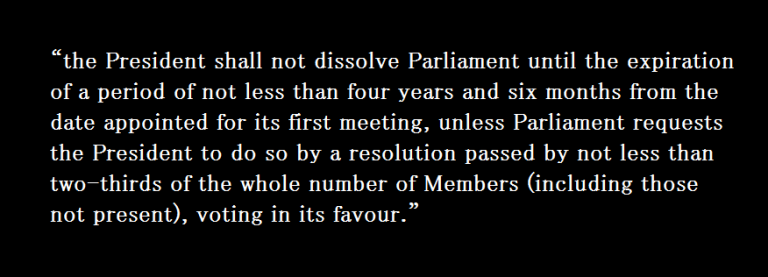
The Nineteenth Amendment, which was passed with just one Member of Parliament opposing it, reduced the term of Parliament to five years. Provisions that Supreme Court held required a Referendum were amended or dropped. Article 70 of the amended Constitution restricted the power of the President to dissolve Parliament. It now provides that “the President shall not dissolve Parliament until the expiration of a period of not less than four years and six months from the date appointed for its first meeting, unless Parliament requests the President to do so by a resolution passed by not less than two-thirds of the whole number of Members (including those not present), voting in its favour.” Thus, Parliament can now be dissolved by the President in the first four and a half of years of its term only if 150 Members of Parliament so request by a resolution passed in Parliament. The wording is clear and unambiguous.

Those who argue that the President’s power to dissolve Parliament is unlimited point out to Article 33 (2) (a) which states: “In addition to the powers, duties and functions expressly conferred or imposed on, or assigned to the President by the Constitution or other written law, the President shall have the power–

(a) …..

(c) to summon, prorogue and dissolve Parliament…”.

 It is argued that Article 33 (2) (a) overrides Article 70. Article 33 only declares some of the general powers of the President. The manner in which and the conditions under which that power of dissolution can be used are given in Article 70. That Article states that dissolution shall be by Proclamation. Then it goes on set down the clear limitation that the President cannot dissolve for four and a half of years unless Parliament so requests by a two-thirds majority. Any power that the President claims under Article 33 (2) must not be in violation of express provisions of the Constitution. The words “In addition to the powers, duties and functions expressly conferred or imposed on, or assigned to the President by the Constitution or other written law…” cannot be used to override expressly laid down constitutional limitations on the powers of the President.

Wrong interpretation of Article 33 (2)

Take Article 33 (2) which provides in sub-paragraph (f) that the President has the power “to keep the Public Seal of the Republic, and to make and execute under the Public Seal, the acts of appointment of the Prime Minister and other Ministers of the Cabinet of Ministers, the Chief Justice and other judges of the Supreme Court, the President of the Court of Appeal and other judges of the Court of Appeal, and such grants and dispositions of lands and other immovable property vested in the Republic as the President is by law required or empowered to do, and to use the Public Seal for sealing all things whatsoever that shall pass that Seal…”

 Can the President take cover under this provision and appoint the Chief Justice and other judges of the Supreme Court on his own? Clearly not, because Article 41C requires the approval of the Constitutional Council for such appointments.

 Article 4 says that the President has executive power. Can the President make appointments to posts in the public service citing Article 4 in isolation, disregarding express constitutional provisions relating to the Public Service Commission?

 If the argument that the President can dissolve Parliament at any time at will is correct, then Parliament can be dissolved by the President just one day after the new Parliament meets, even if he had dissolved the previous Parliament before it completed its full term. This was something that the President could not have done even before the Nineteenth Amendment. This shows the absurdity of the argument.

Sri Lanka: Free Trade Zone TU condemns violation of “People’s Sovereignty” using Constitutional provisions

Free Trade Zones & General Services Employees Union/ Statement to Media.

We condemn violation of “People’s Sovereignty” using Constitutional provisions

By now the country is slipping into some form of anarchy. Beyond the prorogation of the parliament, some State institutions have come under groups who decide for themselves by force leading to anarchic situations in a country without proper governance. This is a direct result of President Sirisena ousting PM Ranil Wickramasinghe by appointing Kurunegala District MP Mahinda Rajapaksa as PM on Friday night on 26 October (2018).

The only way this could be turned into a constitutionally acceptable move is by establishing a clear majority in parliament. Reason for parliament to be prorogued till 16 November is to collect the required numbers. There had been umpteen number of such cross overs in this parliament. There are politicians who remain as Ministers, despite change of governments over the decades. This was also how the 2015 January government change was orchestrated. Then too, the opposition leader who had no majority in parliament was appointed PM and a majority was worked out on the strength of the presidency.

Allowing and tolerating such low political culture is what provides politicians the space to violate the sovereignty of the people in electing decent governments. Sovereignty of the people is an inalienable constitutional right. It is the people who have the right to change and elect governments. We strongly believe and are convinced the President should not be allowed the right to change governments for his own political and personal necessities.

We do have very serious issues with this “good governance” rule over workers’ and trade union rights. We, along with other oppressed people have serious and real issues with this government’s economic policy that has led to a dramatic collapse of the Rupee value, resulting in steep increase in cost of living and a fast decline in efficiency and quality of essential services. It is the working class and the people who therefore have the right to decide on the fate of this government. If the sovereign right of the people to change and elect governments are allowed to be suppressed by these constitutional coups, it would allow workers’ and human rights and civil liberties to be suppressed as well.

We therefore demand a parliamentary election to honour the people’s right to sovereignty in electing a government of their choice.

For the working people, it is on their organised strength as trade unions they could campaign for and win their rightful demands for decent work and wages. With such strength, it is in co-operation and in solidarity with other oppressed people including fishermen and peasantry that workers could further strengthen their struggles. Therefore, in this very unstable situation amidst the conspiracy, we will have to depend on our strength to place before society, our main demands,

  • safeguard the Employees’ Provident Fund (EPF) and the Employees’ Trust Fund (ETF)

  • remove taxes placed on EPF, ETF and gratuity paid for workers

  • the minimum national monthly wage to be Rs.25,000 and

  • to resurrect the Labour Department as a State department meant to safeguard employee interests and campaign for them in broad alliances.

Anton Marcus

Joint Secretary

Free Trade Zones & General Services Employees Union

29th October 2018

Allow Parliament to demonstrate its confidence by voting immediately when reconvened, says EU

JOINT STATEMENT;

The Delegation of the European Union issues the following statement in agreement with the EU Heads of Mission as well as the Ambassadors of Norway and Switzerland resident in Colombo.

The Ambassadors of the European Union, France, Germany, Italy, Netherlands, Romania, the High Commissioner of the United Kingdom, as well as the Ambassadors of Norway and Switzerland take note of the summoning of Parliament as indicated in the Gazette. We consider it essential that Parliament be allowed to demonstrate its confidence by voting immediately when reconvened, in order to resolve the serious uncertainties currently facing the country. Any further delay could damage Sri Lanka’s international reputation and deter investors. Respect by all stakeholders for the  provisions of the constitution will be important to maintain the confidence of the Sri Lankan people in democratic governance and the rule of law.

Sri Lanka’s political crisis explained, and what it means for the island nation’s Tamil community – Kumaravadivel Guruparan

Image: Many Tamil activists see the ousted Ranil Wickremesinghe as less brutal than Mahinda Rajapaksa.
by Kumaravadivel Guruparan.

In November 2014, Maithripala Sirisena, who was then a cabinet minister and member of the Sri Lanka Freedom Party, broke ranks with his leader, President Mahinda Rajapaksa, and agreed to be the common presidential candidate of the Opposition, led by the United National Party. Sirisena won the election in what was then hailed as a “democratic revolution”.

He undid that “revolution” on October 26 this year when he sacked Ranil Wickremesinghe as prime minister and appointed Rajapaksa in his place. He did so ignoring the constitutional amendment he had helped pass after coming to power in 2015, which had done away with the president’s power to remove the prime minister. He thus triggered what is being called Sri Lanka’s first unconstitutional transfer of power – a coup.

Why did Sirisena take this extraordinary step?
First, Sirisena won the 2015 presidential election on the strength of the votes of the minorities – Tamils, Muslims and Malayaha (up country) Tamils. He lost the Sinhala vote to Rajapaksa. It was clear from the very beginning that Sirisena suffered from a sense of inferiority at the fact that despite being head of state, he was not recognised as leader of the Sinhala Buddhists, the country’s majority community.

Second, Rajapaksa was growing in popularity and, according to analysts, stood a very good chance of emerging as the leader of the single largest party in the next general elections. Sirisena wanted to strike a deal with Rajapaksa so that he could be his party’s presidential candidate in January 2020 – and hence the offer of prime ministership to Rajapaksa.

Third, Sirisena did not want to go down in history as the leader who split the Sri Lanka Freedom Party, to which he has dedicated more than 40 years of public life. After he won the presidential election in 2015, he became the leader of the party while Rajapaksa went on to form his own political party, the Sri Lanka Podujana Peramuna.

Tamils, Sirisena and Wickremesinghe

There was a lot of hype around candidate Sirisena within the Tamil community in 2015 – similar to the hype over President Chandrika Bandaranaike Kumaratunga in 1994 and Prime Minister Ranil Wickremesinghe in 2001, all of which was short-lived. But some within the community warned that a close look at Sirisena’s policies showed that these were only cosmetic changes.

Wickremesinghe, who heads the United National Party, was appointed prime minister soon after Sirisena’s election victory in January 2015. He solidified this position with a parliamentary election victory in August 2015. One of Wickremesinghe’s early priorities was to come up with a “transitional justice” programme to appease the United Nations Human Rights Council. The Council had passed a resolution every year since 2012 “promoting reconciliation, accountability and human rights” in Sri Lanka and calling for an independent inquiry into wartime atrocities in the closing stages of the country’s 26-year-long civil war with the Liberation Tigers of Tamil Eelam that ended in 2009. Wickremesinghe had claimed during the elections that it was Rajapakasa’s mismanagement of foreign policy, particularly his decision to side with China, that had led to the resolutions. The government led by Sirisena and Wickremesinghe, hence, took the extraordinary step of co-sponsoring a resolution at the UN Human Rights Council in 2015 that, among other things, promised to set up a hybrid court to investigate war crimes. This was part of their plan to unhook Sri Lanka from the Council.

The hybrid court is yet to be set up. Parliament passed legislation to create an Office for Missing Persons in 2016 but it took the Sirisena-Wickremesinghe government another two years to appoint its commissioners. This year, an Office for Reparations was formed but it has been severely criticised for lacking independence. Some land occupied by security forces during the armed conflict has been released. Some political prisoners have also been released but the government has shown a lack of political will to coherently address this matter. The Prevention of Terrorism Act is to be repealed and replaced by a Counter Terrorism Act, which leaves out some of the most draconian elements of the current legislation but is still fundamentally incompatible with global human rights standards. For more than 600 days now, the mothers of those who disappeared in the final stages of the war have been out on the streets in the country’s north and east, but have received no concrete response from the government. (Wickremesinghe had said in an interview in 2016 that the disappeared were probably dead). Tamils have been protesting in Keppapilavu, Mullikulum, Valikamam and many other parts of the north and east.

Sirisena and Wickremesinghe also did nothing to reform the security establishment. Surveillance continues and attacks on activists working with the families of the disappeared are on the rise. Just days into the new regime, threats from the Sri Lankan Army intelligence, Criminal Investigation Department and Terrorism Investigation Department towards activists have escalated at an alarming speed.

Transitional justice was, hence, just smart foreign policy for the Sirisena-Wickremesinghe duo. Wickremesinghe knew he would not be implementing the 2015 UN resolution co-sponsored by his government but that he needed it to win over the West and show allegiance to the liberal international order.

No structural reforms, only cosmetic improvements

Colombo civil society and the international community have criticised, mildly, progress made under the Sirisena-Wickremesinghe government as “slow progress”. We were advised by the diplomatic corps, colleagues in Colombo civil society and the Tamil National Alliance, the largest Tamil political party in Parliament, which is cosy with Wickremesinghe, not to “rock the boat” by asking for “too much” reform. But the Tamil community knows that without structural reforms, some of the changes – including the small space for protest and dissent that emerged with the change of regime in 2015 – will be immediately reversed by a successive regime that comes to power on the strength of a Sinhala Buddhist nationalist backlash. This is exactly what we fear is going to happen if or when Rajapaksa succeeds in proving his majority in Parliament and is confirmed as prime minister, or if and when he wins the next general elections. Sirisena has agreed to summon Parliament on Wednesday in response to demands for a floor test.

On Friday, the Tamil National Alliance with 15 MPs announced its support to Wickremesinghe. They cloaked it as a vote against Rajapaksa (and not necessarily a vote for Wickremesinghe). Their vote will be very important in deciding who will be prime minister. The Tamil Civil Society Forum asked the party to use this opportunity to demand certain things in return for their support. But the party has made no demands and received none in return. Many activists in Colombo and abroad are critical of Tamils who demand that the Tamil National Alliance extend only conditional support to Wickremesinghe. They say that Wickremesinghe is necessary for better rule of law. What they mean is that Wickremesinghe will be less brutal in his tactics than Rajapaksa. The Tamils are thus condemned to choose between two security regimes. Every time we can make a difference, we are asked to support the actor that can guarantee, albeit marginally, our existence. The reductionist reading of the Tamil struggle for self-determination, justice and accountability to a mere existentialist struggle will solidify Sinhala Buddhist ethnocracy in Sri Lanka, slowly but surely.

Kumaravadivel Guruparan is Senior Lecturer in Law at the University of Jaffna, Spokesperson for the Tamil Civil Society Forum, and Executive Director of the Jaffna-based Adayaalam Centre for Policy Research.

Scroll.in