Home Blog Page 100

Sirisena’s action has plunged the country in to a political crisis: Follow the due process – NPC

The dismissal of Prime Minister Ranil Wickremesinghe following the withdrawal of the SLFP headed by President Maithripala Sirisena from the government alliance has plunged the country into a political crisis. The president has appointed former president Mahinda Rajapaksa as the new prime minister.  The changing of governments and leaders is part and parcel of democracy.  But due process needs to be followed, the constitution must not be not violated and the Rule of Law must prevail when such changes take place. Prime Minister Wickremesinghe has contested his dismissal, and the appointment of a new Prime Minister, on the grounds that it does not conform to the 19th Amendment to the constitution.  The legality of the Prime Minister’s dismissal needs to be resolved by the Supreme Court.

Despite violent conflicts in the past, Sri Lanka can take pride in the fact that transfer of power to successive administrations was achieved through democratic electoral processes. Parliamentary democracy is a public process not a secret enterprise.   The most urgent need is for Parliament to meet and find ways and means to resolve the crisis.  Therefore the National Peace Council is not in agreement with the President’s action in proroguing Parliament until November 16. We call on the President and Speaker to immediately convene Parliament to enable the person with majority support to be declared the Prime Minister.

 Even as the political crisis continues the National Peace Council notes the need to maintain discipline in institutions to prevent individuals taking laws into their own hands.  Sri Lanka can ill afford unruly takeover of media and other government institutions that can lead to violence between competing political interests. Law enforcement officials need to ensure that the Rule of Law is maintained at all costs despite their own political leanings.

It is particularly distressing to us that the steady progress that the country was making in the area of post-war reconciliation could be jeopardized as a result of the political instability that has now besets the polity.  In the course of this year the government alliance set up the Office of Missing Persons, returned military occupied land to the civilian population in the north and east, passed legislation to establish an Office for Reparations and the cabinet of ministers approved draft legislation for a Truth Commission.  We strongly affirm that these are achievements that need to be built upon and not reversed.

Protect UNP leaders until a Prime Minister secures parliamentary majority – Speaker Karu Jayasuriya

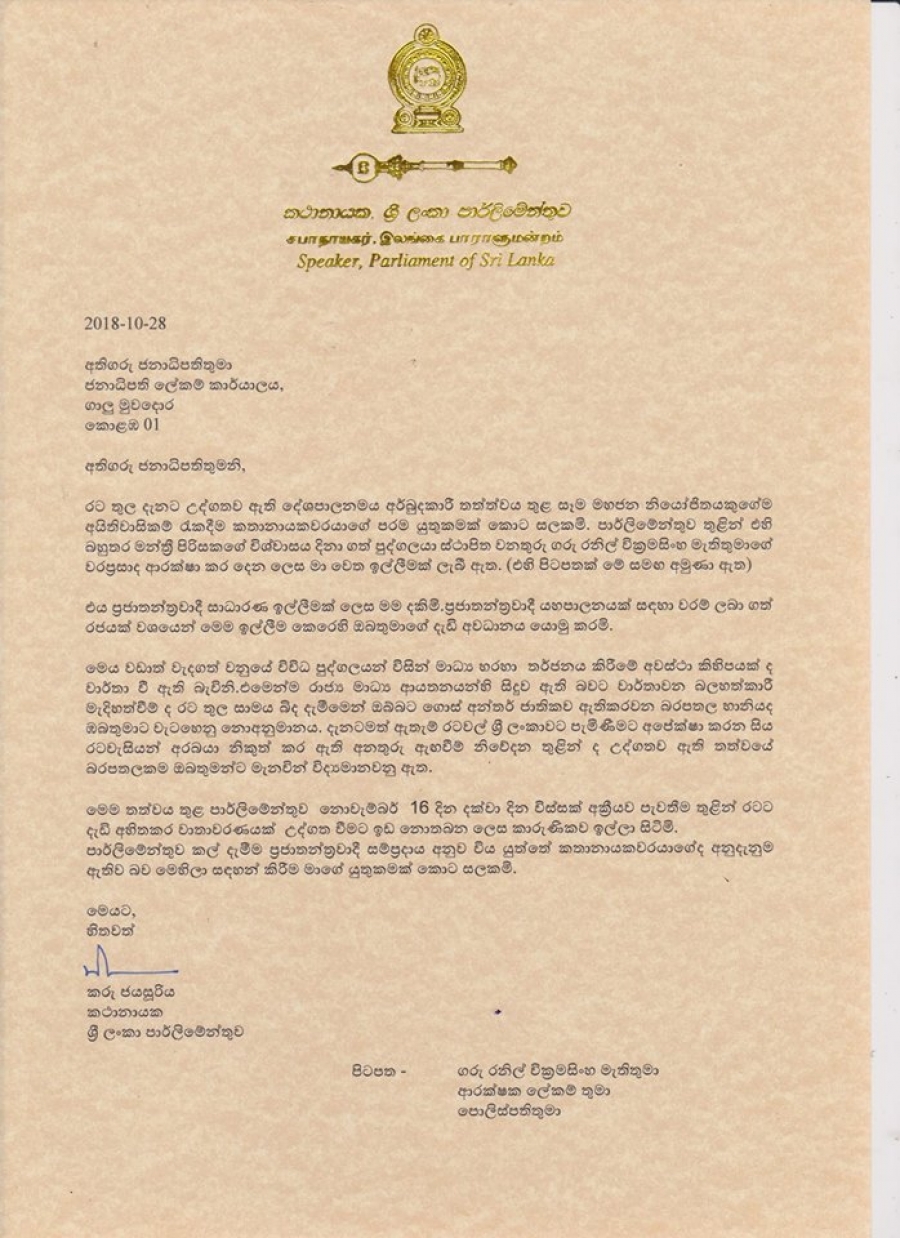
In a major development, Speaker Karu Jayasuriya has requested President Maithripala Sirisena to protect privileges of UNP Leader Ranil Wickremesinghe until the person with a Parliamentary majority establishes as the Prime Minister.

The Speaker, writing a letter to the President, says the request presented by the UNP is fair.

He emphasized that the President, as a leader who obtained a mandate to uphold good governance, should closely look into the matter.

He also says that Proroguing Parliament for 20 days may lead to instability. The recent incident reported in state media institutions, travel advisories issued by foreign country and concerns expressed by various parties highlight the gravity of this situation, Jayasuriya says in his letter.

He also adds that proroguing Parliament should happen with the consent of the Speaker, according to Parliamentary traditions.

The continuation of the Rajapaksa black decade starts again – Anura Kumara Dissanayaka

What has been set up is a continuation of the black decade that existed before 2015. This collective has been assembled for an ugly power gamble in the country. We call upon the masses to pay attention to build the broadest center to win their rights says the Leader of the JVP Anura Dissanayaka.

Mr Dissanayaka was speaking at a press conference held at the head office of the JVP at Pelawatta held today (27th).
He said, “This press conference is held today to tell the country the viewpoint of the JVP regarding the political changes that were carried out yesterday night and what could happen in the future.

Ranil’s corruption

We all know that a broad political movement was built for the presidential election in 2015. An immense task was carried out on behalf of this by political parties, civic organizations and citizens. However, the people’s power that was built was totally plundered by Ranil – Maithri ‘joint’ administration and throughout the last 3 ½ years carried out moves against the mandate they received. Ranil Wickremesinghe and Maithripala Sirisena took turns in protecting fraudsters on behalf of their power hunger. The power change in 2015 included the aspiration of the people to build good governance without frauds and corruption. However, Ranil Wickremesinghe and his partners engaged in large-scale frauds completely ignoring the mandate.

The mandate included hopes for minimum relief for the masses who were pressurized with economic hardships and wishes for developing education and health services. However, Ranil – Maithri administration continued to oppress the masses, by plundering their assets, burdening them with various kinds of taxes, increasing prices of essential goods daily. The mandate also included protecting resources of the country and building the economy of the country. However, what was done was to destroying national resources and the two of them carried out an administration for 3 ½ years hindering the mandate. The decisive act of this was carried out by President Maithripala Sirisena on the 26th. He threw away the aspirations of the masses who brought him to power and took the hands of the group that was his enemy.

Rajapaksa’s ‘black decade’ starts again

What does this political occurrence tell us? If people want they could learn a political lesson from one incident that thousand books would never teach them. The incidents show the ugly, shameful, conspiratorial and vicious nature of politics in this country. The Ranil – Maithri joint administration is built in 2015 not due to any need of the masses. Ranil wanted Maithri’s support for power. On Maithri, throughout the campaign, talked about the violence he confronted with as a minister. As such, what he had then too was a personal power hunger. Also, both of them got together in 2015 to form a ‘joint’ government and increased the number of ministerial posts to protect their power portions. Maithri and Ranil took individuals who were accused of frauds and corruption during Rajapaksa’s ‘black decade’ into their cabinet. It was not on behalf of the masses.

The ‘national’ government was formed for their power hunger and not on behalf of the people. They toll the people that the ‘national’ government is formed only for two years. However, this was extended at various times. The pseudo ‘national’ government and extending the term were not the interest of the people. Throughout the past these political cliques though they call themselves political parties, joined, separated, fought with each other and later became friends not for the benefit of the people. It was for their power interests.
It is the ugly, shameful, conspiratorial and vicious nature of this power hunger that was revealed to the people in this country on the 26th. On several occasions President Maithripala Sirisena had said if he was defeated at the presidential election in 2015 a situation had been created that all his family members would not be living. What did he mean? He told the country that if Mahinda Rajapaksa had won all the members of Sirisena’s family would have been murdered. After saying his on several occasions Sirisena has taken the hand of Mahinda Rajapaksa.

‘hitan’, ‘hutan’, ‘appaya’

Normally, in politics what is criticized are political points. However, various shortcomings were used including Sirisena’s way of speaking, mannerisms by Rajapaksa camp to condemn Maithripala Sirisena. Various words such as ‘hitan’, ‘hutan’, ‘appaya’ were used to condemn Mr Sirisena. However, Sirisena and Rajapaksa have joined together now. Did they join together to develop the country economically or find a solution for the various crises the country is confronted with?

They are gathering to form the one that existed before 2015. If so, why was it defeated? The people defeated that regime as it had given the people destructive experienced during the black decade. What has been set up is a continuation of the black decade that existed before 2015. Can Maithripala or Mahinda Rajapaksa present a new politics to the country? Who were around them when Mahinda Rajapaksa was sworn in by Maithripala?

The Presidential Commission appointed by President Maithripala Sirisena investigated 34 points. The Commission named Mahinda Rajapaksa as an accused. There are accusations against Weerawansa, Mahinda Yapa. Are others who were around and who were accused by Maithripala Sirisena’s government such as Basil Rajapaksa, Mahindananda Aluthgamage, Rohitha Gunawardene, Johnston Fernando patriots? Why do they gather to one camp? This collective is formed for the ugly power gamble. The Present President in our country is the most bankrupt president. In January 2015 he polled 6.2 million votes. By the 26th he had lost all of them. Also, Mahinda Rajapaksa polled 5.8 votes against Maithripala. Mahinda Rajapaksa too has opposed the mandate given to him. The President wanted to re-establish his power through the ugly, gluttonous, vicious and conspiratorial process. Why did he come out of the government if the country could be developed with Mahinda Rajapaksa?

Why does Mahinda contribute to this? Mahinda’s camp was in a very difficult state without power. Several cases against him and his family members are to be heard in November. Also, those who have tasted power and had been mentally and physically broken down wanted power. That’s why they sought matrimony with Maithripala. It has been proved that they would take an ugly, vicious, conspiratorial move on behalf of their need for power.

We ask the people to understand that the aspirations of 6.2 mandate of 8th January 2015 do not belong to Maithri or Ranil. Ranil as well as Maithri have betrayed the mandate. A new political camp that would be responsible for the mandate and take the country towards a new direction should be built. We, as the JVP, are building such a political front. This power gamble should be stopped. For this, the people should understand what correct politics is.

Members of Parliament will be auctioned from today

Members of Parliament will be auctioned from today. They are to be auctioned like stale vegetables and rotten fish at village fairs. You would be able to see the MPs who would be auctioned. They shouldn’t be given the future of your children or the future of the country. This political occurrence has given the people a good opportunity to learn about politics in this country. We call upon the people to study the situation and learn what is needed. The President should have convened the parliament if he had completed his political gamble. The Prime Minister is appointed by the majority in parliament.

The Parliament has been prorogued conspiratorially. It is learnt that he is about to leave for China. He became president talking about non-violence, abolishing executive presidency and saying he would be the last executive president in the country. Now his actions are completely contrary to what he had said. The Parliament should be convened immediately. Convening Parliament during a political crisis is a right of people’s representatives. The Parliament has been prorogued to complete Maithripala’s conspiracy. According to the Constitution, the President could prorogue Parliament after a three day’s notice. We vehemently oppose proroguing Parliament. We call upon the people in the country to rally to build the broadest center to struggle for rights and against proroguing Parliament”

Lanka Truth

Sri Lanka: New Prime Minister puts rights at grave risk – HRW

Sri Lanka: An audaciously conscienceless extra-constitutional gamble – Kishali Pinto Jayawaradena,

If just a quarter of the time reserved by the United National Front (UNF) for juggling with the 19th Amendment by mediocrities of the day professing to be constitutional experts, cosseting Colombo’s privileged inner circles and crooning over applause by the ‘international community’ had been spent in reaching out to Sri Lanka’s rural and provincial constituenciesto rebuild a shattered deficit of trust, it may not have had to face the constitutional (and perhaps) existential crisis that erupted this Friday.

Precipitating Sri Lanka into chaos

And this country, along with its utterly aghast populace may have been spared the humiliation if not ridicule that the spectacle of two Prime Ministers, both insisting that they are legitimately invoking that title, invited across the world. Doubtless that extra-constitutional gamble on Friday with former President Mahinda Rajapaksa being sworn in as a new Prime Minister by President Maithripala Sirisena while Prime Minister Ranil Wickremesinghe declared to all and sundry that he was still the Prime Minister, was both audacious and completely conscienceless.

And let us be clear. Taking responsibility for precipitating the country into chaos must assuredly rest with the President. With twin strokes of the oath-taking and proroguing Parliament thereafter,with the obvious inference that this was to prevent the UNF demonstrating its numbers on the floor of the House, he has effectively destroyed even the good that he did in 2015, in voluntarily reducing the powers of the Executive Presidency.

The legal and constitutional questions that have arisen will be brought before the Supreme Court by either party to this unseemly imbroglio. It is the Court that will finally decide the issue. That said however, the insistence by a onetime professor of law turned ardent Rajapaksa supporter that the withdrawal of the United People’s Freedom Alliance (UPFA) from the unity Government resulted in the Cabinet ‘ceasing to exist’ with, ipso facto, the Prime Minister also ‘ceasing to exist’ as it were, seems to turn the provisions of the 19th Amendment metaphorically on its head.

A legally incoherent argument

This argument is of course, legally incoherent in its most basic sense. Article 46 on which heavy reliance is put for this less than ingenious interpretation, is limited in its scope to restricting the numbers of Cabinet Ministers that are possible in normal contexts, as opposed to Cabinets formed by a National Government. The question then arises as to what possible rationale can be put forward for invoking that Article to justify the cessation of a Cabinet of Ministers upon one constituent of a National Government leaving it.

Indeed, Article 48 stipulates that a Cabinet of Ministers may be dissolved only in three narrow instances; namely if the Prime Minister ceases to hold office by death, resignation or otherwise, if Parliament rejects the Statement of Government Policy or the Budget or if Parliament passes a vote of no-confidence in the Government. Meanwhile the good professor’s attempt to use the Interpretation Act to buttress his reasoning is astoundingly faulty in that, as any first-year law student is aware, it is the constitutional provision that prevails against a statute.

Regardless, the issue here is not constitutional punditry, in respect of which the enraged UNF will no doubt have enough resources to draw from, skills notwithstanding. Rather, it relates to a greater issue pertaining to paths wrongly taken, cynically disregarding the promises made in 2015. These are the unfortunate harvests that are now being reaped, even as we cannot but recall the fact that as much as there are now, two Prime Ministers, there was in January 2015, two Chief Justices of the country, with one being sent home by executive fiat through a letter of the President while a UNP backed Bar clapped and cheered. There is an uncanny albeit unkind parallel here with the Prime Minister being summarily dispensed with by the President through a letter once again.

A hard but necessary truth

So it is of little use to rail and rant against the President’s betrayal, as some UNP Ministers did on Friday. These are bedtime stories good only for the naïve. Politics is an art of the betrayal. No political leader among those alive today can, akin to Pontius Pilate’s infamy, wash their hands and pretend wide-eyed innocence of this singular sin.

But it must also be said in that same breath that blame cannot be shifted away from the UNF and its most responsible element, the United National Party (UNP) for bringing about what would have seemed quite impossible just a few years ago. That is the hard but necessary truth that we face today. If a wiser and more strategic course had been taken, all the trickery and treachery encountered would not have worked, simply on a political assessment.In the final reckoning, it is political realities that plays a great part in the taking of risks.

And Friday’s calamities were born out of the manifestly great blindness of the UNF Government which it did nothing to correct even when the warning signals were flashing dangerously red. Nothing made that plainer than the heedlessness with which the results of the local government elections earlier this year were treated, despite the people indicating that it had enough of muddled, inchoate and corruption riddled conduct by Government Ministers. The revamping of the party was only in theory while the very same mistakes were made with gay abandon.

Inglorious dimming of what 2015 promised

In fact, the heedlessness was so remarkable that it boggled the proverbial imagination. For example, quite unmindful of the fact that people were finding it harder to scrape daily necessities together, the famous fuel formula that had a ripple effect in raising prices of food items was unveiled by responsible UNF Ministers a few weeks agowith silly grins stretched across their faces.

It seemed close to a farcical play on the scornful remarks, ‘if they don’t have bread let them eat cake’, popularly (but perchance not correctly) attributed to the French Queen Marie Antoinetteguillotined by furious peasants of the French Revolution. Even with the full intent of being as charitable as possible, this depicts a willful combination of arrogance and sheer cluelessness as to the popular mood that is quite startling.

In any event, irrespective of whichever way the political pendulum turns, the unfolding constitutional crisis is likely to be fought out on Colombo’s streets.On Friday night, pro-Rajapaksa ruffians forced their way into state media stations and took over their functioning. Miserable times of uncertainty and chaoswill have a devastating impact on an already highly unstable economy.

It is an inglorious dimming of the bright rays of democratic change in 2015. That is our tragedy.

Act in accordance with Sri Lanka’s constitution, EU tells Sri Lanka Govt

Delegation of the European Union issues the following statement in agreement with the EU Heads of Mission resident in Colombo.

The Ambassador of the European Union as well as the Ambassadors of France, Germany, Italy, the Netherlands, Romania and the UK High Commissioner are closely following the events as they are unfolding in Sri Lanka. We urge all parties to fully act in accordance with Sri Lanka’s constitution, to refrain from violence, to follow due institutional process, to respect the independence of institutions, and freedom of media.

Royal victory for Sri Lanka PM Ranil Wickremesinghe

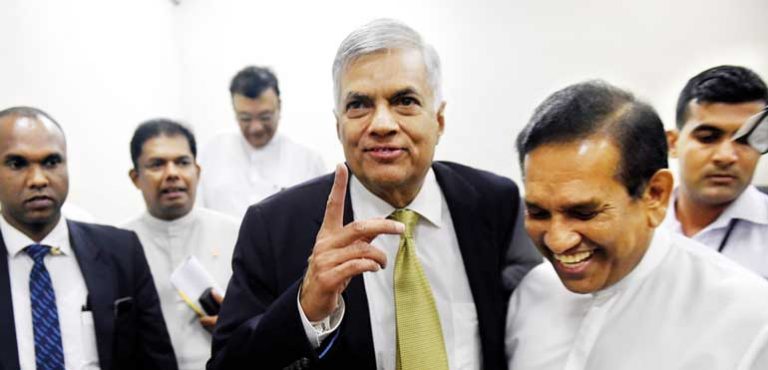
Image: Jubilant Prime Minister Ranil Wickremesinghe gestures along with Health Minister Dr. Rajitha Senaratne after the vote on the No Confidence Motion – AFP

Prime Minister Ranil Wickremsinghe yesterday emerged victorious after he managed to decisively defeat the much anticipated No-Confidence Motion with a comprehensive majority of 46 votes and will meet President Maithripala Sirisena today to decide the future of the government.

At the conclusion of a full day debate of nearly 12 hours Speaker Karu Jayasuriya moved the House for a vote on the motion. The motion against Prime Minister Wickremesinghe received 122 votes in favor and 76 votes against at a division by name. The division was called by Leader of the House Minister Lakshman Kiriella. A total of 26 MP were absent for the vote. Among them were two signatories to NCM Nishantha Muthuhettigama and Karder Musthan.

The UNF voted against the motion in a show of strength, backing the Premier with even dissident MP Wijedasa Rajapakse closing ranks unexpectedly. The minority parties led TNA, SLMC ACMC, Mano Ganesan and P. Digambaram (TPA), who are part of the UNF, bolstered the support for the Prime Minister by voting against the No-Confidence motion. There was eleventh hour change of heart from vocal State Ministers Wasantha Senanayake and Palitha Ranga Bandara as they voted against Motion.

However, as promised, the six members of the JVP voted in favor of the motion. Former President Mahinda Rajapaksa who was absent during the debate, voted in favor of the motion, along with his brother MP Chamal Rajapaksa and son MP Namal Rajapaksa.

Independent MPs Athureliya Rathana Thero and Arumugam Thondaman were absent for the vote.

The SLFPers who voted in favor of the motion included Parliamentarians Susil Premajayantha, Dayasiri Jayasekara, Dilan Perera, John Seneviratne, Lakshman Wasantha Perera, Dr. Sudarshani Fernandopulle, Tharanath Basnayake, Susantha Punchinilame, Anura Yapa, S. B. Dissanayake, Lakshman Yapa Abeywardena, Chandima Weerakkody, Anuradha Jayaratne and Sumedha Jayasena.

Notable SLFP Members of the Government who were absent included Mahinda Amaraweera, Sarath Amunugama, Nimal Siripala De Silva, Duminda Dissanayake, Faizer Mustapha, Ranjith Siyambalapitiya, Wijith Wijyamuni Zoysa, Piyasasena Gamage, Mohan Lal Grero, Sriyani Wijewickrama, MALM Hisbullah, AHM Fowzie, Lasantha Alagiyawanna, Manusha Nanayakkara, Nishantha Mutuhettigama, Indika Bandaranayake and Weerakumara Dissanayake.

The No-Confidence Motion was handed over to the Speaker by the Joint Opposition led by former President Rajapaksa on 21 March carrying the signatures of 55MPs including four SLFP members in the Government ranks. The defeat of the motion ended a 14 days game of cat-and-mouse between the UNP and the Opposition, each trying to garner the required numbers to secure a simple majority of 113 votes.

The vote was called for by Speaker Karu Jayasuriya at 9.30 and finished at 10.00pm. Soon after his victory, a jubilant Prime Minister speaking at a press conference said that the coalition government was still intact and the January 8 mandate must be fulfilled. “A group of MPs abandoned the Government today but we will continue with the rest. I will be meeting the President on Friday on how we are to move forward and discuss the future of the government. The national government will continue. The January 8 mandate given by the people must be fulfilled. We will also be making changes in the UNP. Reforms in the party will be carried out and reorganized,” the Prime Minister said.

Wickremesinghe’s first visit from Parliament was to the Gangaramaya Temple where he worshiped and sought blessings. Soon after the vote the city celebrated with crackers too. Earlier on in the day, a group of senior SLFPers addressing a media briefing at the Parliamentary complex affirmed that President Maithripala Sirisena was the head of the Government and that they would remain in their positions in the Government ranks even though they would vote in favor of the Motion. “It is the President who decides whether we should hold Ministerial positions, not the UNP,” Minister S B Dissnanayake said. Ministers Dayasiri Perera, John Seneviratne, Lakshman Wasantha Perera, Sudarshini Fernandopulle, Tharanath Basnayake, Dilan Perera, Susantha Punchinilame, Anura Priyadarshana Yapa, Susil Premajayantha, Lakshman Yapa Abeywardena, Chanmdima Weerakkody, Sumedha G Jayasena and Anuradha Jayaratne were also present at the media briefing. UPFA joint opposition parliament group leader, Dinesh Gunawardena moved the motion against the Prime Minister Ranil Wickremesinghe in Parliament yesterday morning kicking off the debate.

Taking up the no-confidence motion signed by 55 MPs including four MPs from the Sri Lanka Freedom Party (SLFP) for debate, MP Gunawardena said: “There is no confidence in the Prime Minister. Whether the house has confidence in the Prime Minister or not is a very serious issue. This Government took over on the 8th March for the first time and the Central Bank came under the purview of the Prime Minister. Then a Singapore citizen was appointed to head the Central Bank. There is only one Central Bank in the country and it is a known fact that its governor has the power to influence the country’s economy. The Central Bank, which is traditionally under the Finance Ministry was taken away from the Finance Ministry. Knowing that he would not comply with the country’s accepted financial norms.” Challenging the appointment of former Central Bank Governor Arjun Mahandran he said: “Mahendran was appointed as the Governor knowing that he would not comply with the country’s accepted financial norms under the purview of the Prime Minister. The Prime Minister recommended the appointment of Mahendran and took on the responsibility, which he accepted in parliament.” MP Gunawardena also noted that by appointing Arjuna Mahendran as the Central Bank Governor, the faith in the country’s foremost financial institution has been lost and led the nation to incur heavy losses from malpractices involving the shady deals with the Perpetual Treasuries. “Those responsible cannot escape from their misdeeds. Because of this incident, the Finance Minister had to resign from his post. Those responsible cannot be made to appear innocent,” he added. Minister of Public Enterprise and Kandy Development and Leader of the House of Parliament Lakshman Kiriella rejecting the charges on the Prime Minister said the NCM was brought on baseless allegations.

“Both times when PM Wickremesinghe took office, he appointed an MP from the Opposition as the COPE Chairman. In 2002 it was late Jeyaraj Fernandopullei and it is Sunil Handunnetti of the JVP at present. He also established oversight committees and appointed MPs from the Opposition and the ruling party. He did all these to suggest that the government has nothing to hide. ” Minister Kiriella added. He then highlighted the involvement of the joint opposition MPs in the recent violence against Muslims in certain parts of the country.

“The police were in possession of information on outsiders flocking into Kandy two days prior to Digana incident. I gave a telephone call to the police informing them about the situation and requested them to be vigilant. Six Sri Lanka Podujana Peramuna politicians are behind the recent tense situation in Kandy. Among them, there are two SLPP parliamentarians as well. We do accept that there have been lapses from the part of police with regards to this incident. The police had already received information on outsiders coming to Kandy in groups. But the police did not act on these. Some police stations were very much dedicated in curbing the situation, whereas, some were inactive.” Minister Kiriella said. “So, how could the JO allege that the PM is responsible for that?” he queried Joining the debate, the Leader of the Opposition Rajavarothiam Sampanthan rejected corruption. “With regard to the Central Bank bond scam, consequent to investigations two persons are in custody and a warrant is issued against a third person and investigations are proceeding. No one should be spared, and the rule of law should be implemented irrespective of who they are.” “The motion of No-Confidence seeks to implicate the prime minister with the bond scam. Statements of actions of a general nature are thought to be used in an attempt to implicate the prime minister with the bond scam. The wording of the motion and the timing of the motion are indicative of a pursuit of a political agenda through the motion rather than fixing responsibility with regard to the bond scam,” he said. “The question must be raised as to why the wording is so weak lacking in any specific charge against the prime minister pertaining to the band scam per say. Why should this motion be brought now? The wording of the NCM is too loose and too general in nature. It could be that the Prime Minister is facing this situation because of the confidence he placed in someone who betrayed him. Where is the evidence or charge against the Prime Minister of involvement in the bond scam per say? Is the wording of the NCM so loose and so general because of the lack of specific material against the Prime Minister in regard to the bond scam? If that is so, in my submission the motion lacks credibility. With regard to the timing of the motion, this bond scam occurred three years ago, and it has been the subject of public focus for a long time, so why has this NCM brought against the PM only now? This is a plan to bring down, totally and completely, the present government,” added MP Sampanthan.

According to MP Sumanthiran, the no-confidence motion against the Prime Minister is the first step in the assault against the government of national unity that has the popular peoples mandate. “Perhaps the second would be aimed at the Speaker’s Chair and the third impeaching the President himself. Now that design goes against the mandate of the people of this country from all parts and all communities granted mainly to the two main parties. This Government has received a mandate in particular from the people to fight corruption. In 2015 Presidential election one of the key issues pronounced and people selected a common candidate to fight corruption. There were very serious issues that this country had to face and then get addressed, resolved and the direction of the country to be changed. Persons from varied different political backgrounds joined hands in this exercise.” “All of us worked together and brought about this change. Thereafter the General elections led to form the national unity government. Unfortunately, some who were elected from the UPFA decided to go against that mandate and left the Government of national unity and chose to sit in the opposition. It was the first challenge posed to the national unity government. Today, that group of MPs who worked against the mandate received has preferred a no-confidence motion against the Prime Minister,” he added.

Meanwhile, the Sri Lanka Muslim Congress (SLMC) claimed the No-Confidence motion was another attempt by the Joint Opposition to remove the Premier Wickremesinghe from the 2020 Presidential election race. SLMC leader Minister Rauf Hakeem made these remarks while taking part in yesterday’s debate on the No-Confidence motion. “The SLMC stands with the Prime Minister against the motion and it considers the motion as an attack on the government. The Prime Minister is only a symbol. They just want to damage the government,” he said.He then said that the Sri Lanka Podujana Peramuna was utilizing the suffering of the muslim community to their political advantage.

“The Sri Lanka Podujana Peramuna (SLPP) is attempting to take advantage of the sufferings of the Muslim people and are trying to use it to influence the Muslim MPs. There are attempts to manipulate the SLMC and the Tamil National Alliance (TNA) by those behind the NCM claiming that the government has not been able to guarantee the safety of the minorities.

“For them the suffering of the Muslims is just another factor to manipulate. The shock, the suffering and the damages of the Muslim community has been used to compel Muslim MPs to vote against the Prime Minister. They have also tried to use a speech made by one of our MPs criticizing the response to the Digana communal violence and are trying to convince people that we must vote against the government,” he said.”

UNP demands PM remove Ministers who voted in favour of NCM

A group of 33 United National Party (UNP) MPs yesterday (4 April) urged Prime Minister Ranil Wickremesinghe to remove Ministers who voted in favour of the No-Confidence Motion, insisting that it was ‘despicable’ and was against the people’s mandate given in 2015.

The letter signed by UNP MPs requested Premier Wickremesinghe to remove Ministers S. B. Dissanayake, Dayasiri Jayasekara, Susil Premajayantha, Anura Priyadarshana Yapa, Chandima Weerakkody and John Seneviratne, who voted against him yesterday at the No-Confidence Motion.

While the majority of the Government members were working towards a common goal of developing the country, the UNP MPs claimed, this group of Ministers had been constantly disrupting the work and criticising the Cabinet decisions in a loathsome manner in the media.

“This group of Ministers within the Government had always undermined the mandate given by the people in 2015,” the UNP MPs charged.

By Skandha Gunasekara and Ashwin Hemmathagama

Daily FT.
Sri Lanka bond scam: Ruling UNP in trouble; Will Prez Sirisena benefit?

Prof. Jayadeva Uyangoda.

As the media predicted last week, alluding to an off-guard comment made by a junior member of the Attorney-General’s legal team of the Presidential Commission of Inquiry into the Central Bank bond scam, a star witness has turned the public discussion on high profile corruption into a major political drama.

Ms. Anika Wijesuriya, a young female entrepreneur from an extraordinarily rich business family in Colombo, has done what the Joint Opposition of ex-president Mahinda Rajapakse, or Mr. Anura Dissanayake’s radical JVP, has failed to achieve in more than two years.

In half a day of evidence before the commission of inquiry, she has rocked the very foundations of the current yahapalanaya regime. She has also changed the terms of the political debate between the government and the opposition. All these unwittingly though.

Ms. Wijesuriya’s evidence provided a detailed account of questionable financial deals between the family of Ravi Karunanayake, the former Finance Minister, and Arjun Aloysius, the young businessman whose name has figured as the main actor in the massive bond scam. To make the drama unbelievable, Aloysius happens to be the son-in-law of the Central Bank Governor, Arjuna Mahendran – son of a longstanding UNP stalwart – who oversaw all the transactions, including the bond auctions, of the Central Bank. Mahendran as well as Prime Minister Wickremasinghe, and his cabinet team of economic whiz-kids, did not seem to have any idea about the principles of conflict of interest and public trust. In the process, Ministers Harsha de Silva and Eran Wickramaratne also lost their credibility in a rather sad manner.

Karunanayake’s claim to innocence before the supreme court judges through pleading ignorance of those deals over the renting of the penthouse apartment was not only unconvincing, but also appeared to be out and out deceit. Denial has made his case most indefensible. And the yahapalanaya government now finds itself in its most serious crisis since it was formed in January 2015. The UNP, led by Prime Minister Ranil Wickremasinghe, has fallen victim to its own false promise of corruption-free good governance. After Wickremasinghe went lackadaisical about the corruption inquiries into the dealings of the big wigs of the Rajapakse regime for obviously narrow political reasons, he now faces what one may call the poetic justice.

Unless Karunanayake resigns or is sacked from the cabinet, the UNP will be in deep trouble. Even then, problems for the UNP will not be over. Attempts to recover the lost moral high ground by making claims to renewed yahapalanaya spirit will not help Prime Minister Wickremasinghe or his UNP. People, even those who supported him and his government, are now totally disenchanted with his politics of deception and tactics of deceit on the bond scam. He is facing a truly serious crisis of credibility before the citizens. Re-building that lost trust between the prime minister and the citizens will require a wholesale clean-up of the UNP section of the present coalition government. That process might even put his own position at risk. Meanwhile, under normal circumstances, democratic politicians who lose public trust so badly tend to look for authoritarian alternatives. Wickremasinghe has no access to that option either, thanks to the much-maligned system of diarchy introduced by the 19th Amendment.

Who is the immediate beneficiary of this crisis? President Sirisena or the former President Mahinda Rajapakse, or Anura Kumara Dissanayake, the JVP leader? Rajapakse is unlikely to benefit much, even though the joint opposition will try to make political capital out of the UNP’s crisis. The Rajapakse brothers and sons have not replied to the allegations of massive scale corruption in any manner that can bring back any political credibility to the former first family. The Rajapakse outfit, with its claims to having a couple of advisors or propagandists with some academic credentials, is one with no sense of self-criticism whatsoever. Sri Lankan voters are not lured by the personality cult alone. The JVP will certainly benefit from the UNP’s predicament, since their MPs have been in the forefront of the anti-corruption campaign, particularly exposing the central back bond scam.

The person who can benefit most from the UNP’s crisis is President Maithripala Sirisena. Unlike the Prime Minister, President Sirisena has not got his own Mr. Clean image badly tarnished by defending, and covering up, the misdeeds of the former Central Bank governor. But President Sirisena does not have a totally clean slate either. He is also surrounded by a bunch of people with little credibility when it comes to the question of corruption while holding political office. Some of them joined him after the December 2014 elections primarily to avoid investigations and prosecution. President Sirisena does not hide it, especially when he tells even his sympathetic critics like me: ‘an ounce of political practice is more valuable than a ton of political theory’.

It is against such a backdrop that the citizens and anti-corruption activists should show immediate interest in the meticulous investigations conducted by the lawyers of the Attorney General’s department. The latter are professionals who have not been known for being so efficient in their normal corruption investigations and prosecution during the past so many years. Yet, suddenly they have found a new spirit of professional efficiency, pride and commitment. In what particular way the yahapalanaya agenda has contributed to that change is not yet clear. However, before the investigating agencies and public prosecutors become fatigued or intimidated, citizens must ask them through President Sirisena to investigate all those whose names figure in the 5,000 odd pages of transcripts of Mr. Arjun Aloysius’s short messages, which the Attorney-General’s Department has produced before the Commission. Obviously, Ravi Karunanayake is only one among many political and bureaucratic names mentioned in those messages. Moreover, Aloysius’s phone messages with incriminating data might have a history going back to days well before January 2015, as should his Central Bank’s bond business too.

Such a demand by citizens, the media and civil society groups for full disclosure of Aloysius’s messages should not be motivated by partisan politics. It should not aim it proving the mere point that all are corrupt. Citizens already know it. What is not known are the data, evidence and concrete information how the nexus, or the unholy alliance, between the business and politics works to the detriment of democracy, good governance and public welfare. Just briefly look at Ms. Anika Wijesuriya’s evidence. She gave the Commission startling details about how businessmen and politicians make and operate mutually beneficial deals involving public money as well as hoarded private funds of enormous proportions. These businessmen and politicians are close family friends. They have close school ties through themselves, their spouses, lovers, and children.

In Ravi Karunanayake’s case, the alliance is between the alumni of the Royal College and the Colombo International School. These are not the Sinhala or Tamil speaking vernacular godaya mudalalis. They are men and women from a small class of the unbelievably rich. All the men wear expensive suits. They are children of the open economy and globalization. They freely loot the public wealth as if it is their right and privilege. A new class of businessmen and politicians, with insatiable greed for accumulation of money and material wealth began to capture the state power. In the investigations into some of them under the yahapalanaya regime, the same processes and structures seem to continue with a few new names replacing the old.

When a big minister looking for a house, a businessmen volunteers to donate a rent free pent house apartment. The minister accepts all this with no idea of conflict of interest or the principles of governance he himself promoted when out of power. Obviously, this is only the tip of the iceberg. Young Ms. Onella Karunanayake is absolutely right. Why only target her father, when there are so many who have been doing it?

The citizens, the media and civil society groups must demand from President Sirisena to continue these probes through presidential commissions on previous bond scams as well. There is now forgotten Greek bond issue which the UNP leaders told us that days that it cost the country billions of rupees. Obviously, there have many Aloysius’s in Colombo who made a lot of money on bond business. And also politicians and officials who amassed ill-gotten wealth through these deals. Targeting a few individuals like Karunanayake, Aloysius and Mahendran is not enough.

The entire system needs to be cleaned up. That is the yahapalanaya promise. That is what the citizens expect from President Sirisena. That is also the only way he can prove himself to be a statesman, qualitatively different from the Rajapaksas and Wickremasinghes.

Meanwhile, citizens of Sri Lanka should thank the Presidential Commission for providing a forum where concrete details about the unholy alliance between business and politics are exposed. These are details that cannot be obtained under the RTI Act. Neither have such details been discovered by the government’s investigating agencies about highly publicized corruption allegations against the powerful individuals of the previous regime. Now, citizens have some concrete data about how domains of business and politics allow themselves to be interpenetrated and how businessmen capture individual politicians, political parties and even government’s decision-making process. Now, we have a slightly better idea of how our democracy gets distorted by this business-politics nexus.

Obviously, Sri Lankan citizens can now begin to re-think their political loyalties, electoral strategies and expectations.

Courtesy Groundviews.

Minister Ravi Karunanayake should resign – Dr Paikiasothy Saravanamuttu

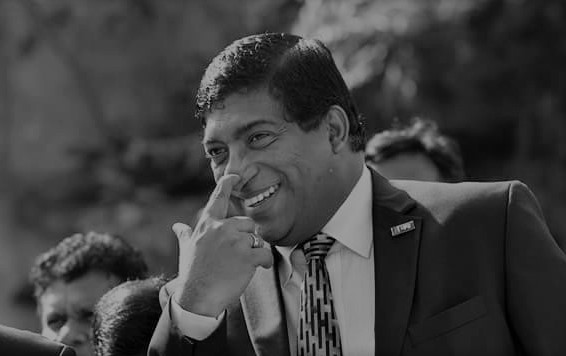
Image: Minister Karunanayake checking his nose to make sure is it growing!

The Centre for Policy Alternatives (CPA) has followed recent media reports of the proceedings of the Commission of Inquiry to investigate the issuance of Treasury Bonds with increasing concern. The reported allegations of financial misconduct and conflicts of interest are extremely serious and their political consequences graver. Whatever the outcome of the Commission’s proceedings., the allegations are of sufficient gravity to require the immediate resignation of Ravi Karunanayake MP, the Minister of Foreign Affairs.

The media reports of the on-going hearings of the Commission of Inquiry to investigate and inquire into the issuance of Treasury Bonds during the period of 1st February 2015 to 31st March 2016, (CoI), reveal that Mr Karunanayake is implicated in financial transactions with Mr Arjun Aloysius, a central figure in the high-profile and questionable issuance of bonds by the Central Bank. Witness testimony to the CoI states that a luxury apartment in Colombo was taken on lease by Mr. Aloysius and/or his representatives, and paid for on behalf of Karunanayake, who was then Minister of Finance, and his family. In recorded testimony given to the CoI on 2nd August 2017, Minister Karunanayake noted that it was his wife and daughter who found and procured this apartment and that he personally “knew nothing” about how the apartment he and his family resided in for nine months was paid for and procured.

Without prejudice to the proceedings of the CoI, CPA finds the Minister’s testimony not only entirely implausible, but also deeply damaging to the credibility and reputation of the institutions of government.

This is especially so for a government elected on a platform of good governance and anti-corruption. We firmly believe that this is a view shared by the majority of our fellow citizens, who are dismayed by the persistence of corruption and the current government’s woefully inadequate measures to address it.

CPA wishes to remind the government of its central promise to eradicate corruption at all levels of government and to hold to account anyone who is complicit without fear or favour. We call upon Minister Karunanayake to take the principled step of resigning from ministerial office forthwith, and to cooperate fully with on-going and any future investigations. We believe this is an essential prerequisite for restoring public confidence in the government’s commitment to its mandate, and we reiterate that the failure to do so will seriously impede the realisation of every other aspect of the government’s reform agenda.

Given the hope and expectation raised in 2015 regarding the restoration of good governance and the rule of law, the failure of Minister Karunanayake to resign, and the failure of the government to ensure his resignation, will risk unfavourable comparison with its predecessors. More critically, it will erode the credibility of our public institutions and processes in the eyes of citizens, and fatally undermine broader reforms.

Dr Paikiasothy Saravanamuttu
Executive Director

August 04th 2017, Colombo, Sri Lanka: